Saturday, May 8, 2010

I Make Fun of State Quarters: Bears Took Over Alaska

By one depiction, Alaska is a black hole of civilization (even if there's a few months where the sun never goes down, but then again light gets sucked into a black hole). By this logic, those guys who came up with the term "Seward's Folly" to describe the decision of Lincoln's Secretary of State to by an enormous chunk of land from Russia on the cheap were right. Not so much because they thought it would be a "hostage territory" vulnerable to foreign invasion (though the Japanese still fought pretty damn hard for a few fragments of the Aleutians during World War II) but because $7.2 million seemed like a lot of money for a desolate swath of tundra and ice. So from the scattered reports that have escaped from the wasteland, it appears Alaska is critically short on women, locked in a losing war with the fearsome moose, packed with kooky politicians who think the Internet is made of tubes and Democrats are embarking on a mission of pulling the plug on old people, and uncomfortably mixing a reliance on alcohol with the greatest ratio of pilot's licenses in the nation.

The other interpretation is that Alaska is a terrific place with some of the best natural beauty in the country. Seward's purchase gave the nation a new tallest mountain, as well as a plethora of amazing forests and rivers and wildlife. And residents came up with the crazy-but-fun-sounding ideas of an epic sled dog race and a bloodying scramble up the shale-littered slope of a mountain. Not to mention all that oil and timber that comes out of the deal.

So grinding all of those traits in a blender yields this:


"And the number one threat to America..."

Alaska was one of the last states to enter the Union and, correspondingly, one of the last states to get a quarter in the program. Designed by Charles Vickers and released on August 23, 2008, the quarter quite simply depicts a huge friggin' grizzly bear snagging a salmon from an isolated river. The only other features to point out are the inscription "The Great Land" (referencing the fact that Alaska could crush much of the continental U.S. if dropped on it) and the North Star, hidden off to the side of "1959" and likely a reference to the magnetic colorstorms that are nicely visible in the state.

There might be some hidden references to other aspects of Alaskan life here, such as the hint of a tree on the shore referencing forestry and/or the natural beauty of the state. And the fact that bears have either massacred all of the residents and taken over the state, or at least ousted all human fishermen and monopolized the salmon market.


They took our jobs! But they're so cute...

It's a little tough to take on the Alaska state quarter. While searching around, I discovered that the crew over at Rifftrax deemed it the most awesome state quarter of the whole bunch. This duo made up the meat of Mystery Science Theater 3000, and in their final showdown they gave Alaska the coveted title over Wisconsin, despite their strong ties to the state from childhood and university studies. It would be a little difficult to match these wits in a battle to mock state quarters, so I'll just sum up that they felt the Alaska quarter was legitimately awesome while the cheese and cow of the Wisconsin quarter were only awesome in an ironic way.

And then there's this:

Governor Palin unveils Alaska's two-bit competitor of the AK-47

With the release of quarters once again corresponding to important events, the Alaska quarter went into circulation only six days before John McCain announced that Sarah Palin would be his running mate in the 2008 presidential election. And if you didn't like the bear design, you can at least be glad that the schedule wasn't tweaked to have the quarter released a year later. If that was the case, the GOP probably would have clamored to have Palin smiling beneath the banner reading, "You betcha!"

Monday, April 26, 2010

Nostalgia in the Trash

Like most people, I'd guess, my outlook on the day seems to improve as the week goes on. I've had Mondays where I look on the morning as the last bastion of the weekend and try to enjoy eating breakfast and reading the paper as much as possible before another five days of work get underway. And then Tuesday seems a little better (especially when it's capped by either a gaming session with friends or, failing that, an episode of Lost). And Wednesday is OK, and Thursday is pretty decent, and who the hell doesn't love a Friday?

But Monday mornings can be a little dreary, and so that might have been why I was hit with a bit of sadness when I looked in my trash this morning and saw this:

Oh expired Burger King coupon book, I hardly knew ye.

Well, that's almost what I saw...the yogurt cup is from lunch and would be in my recycling bin if the transfer station bothered to take more plastics. And I don't really care about the wrapping from a roll of Hannaford-brand paper towels or the butter-encrusted bag of Jolly Time from the weekend's Netflix fest. So that leaves that SuperAmerica Speedy Rewards membership card right there on top.

It was both a lazy and productive weekend, and yesterday I opted to do some overdue cleaning. When I went through my desk drawers, I found a few things that could be tossed out. One was a little plastic SA Speedy Rewards oval, which is designed to fit on a key chain and be easily swiped under a scanner. The program designates point values to certain items in the SA convenience stores, and you can trade them in for rewards such as free drinks or gas discounts. SuperAmerica is a strictly Midwestern affair, and on my last trip to Minnesota I discovered that the points I had accumulated during my college years had expired. So, since my Minnesota trips are few and far between now, I tossed the oval and figured I might as well get rid of the SA card in my wallet while I was at it.

I didn't think anything of it at the time, but saw it in something of a different light this morning. Sure, it's just your standard rewards program card, but it has a bit of nostalgic value related to my time at Macalester College. I got it in my senior year, when I was living in a house on campus and buying gallons of milk on a regular basis. They were a bonus item at that point, worth 200 points apiece, and so I easily earned a couple of treats before milk went out of the rotation. The card also proved its worth on a couple of outings with friends, including a Blockbuster mission with the goal of getting one good movie and one terrible one; donuts were the bonus item then, and proved too good to pass up.

We're walking in the air...We're floating in the moonlit sky...

So basically I saw a bit of my college days lying in the garbage. And it triggered some nostalgia for them, now just about four years gone, and is there any better way to start a Monday morning than with an emotion my somehow surviving Webster's dictionary defines as "a yearning to return to the past"? I had plenty to keep me occupied during the day, but it made me want to write up the incident anyway.

The card is still lying there in the trash can. I have a touch of hoarding instinct; the housecleaning that claimed the SA relics spared a bunch of old National Geographic maps, even though I don't have much use for them. Usually I'll reassess something every time I see it, and eventually it might end up getting consigned to the junk heap or a thrift store. The card may have a couple of small memories attached to it, but it's nothing that isn't stored in my head anyway. And I can't get all emotional over rubbish, after all.

"That fast food bag reminded me of my first date..."

Sunday, April 18, 2010

Greatest Thing of Anything: Robot Hall of Fame

Some time ago, I suggested that all human political frustrations could be solved by the creation of a bipartisan, singularity-driven robot government. Carnegie Mellon University is not quite ready to go that far, but they have certainly taken a step toward honoring our once and future benefactors. In an effort to honor "the fictional and real robots that have inspired and made breakthrough accomplishments in robotics" and "call attention to the increasing contributions from robots to human society," the university created the Robot Hall of Fame.

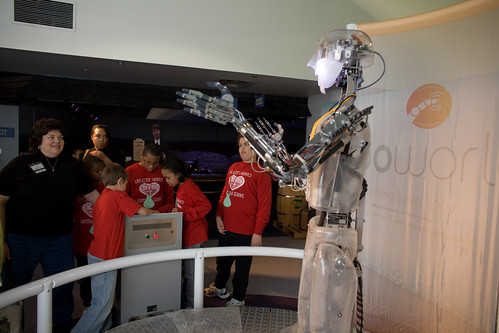
Carnegie Mellon teaches about robots; children hit random buttons and pretend to learn something.

I have not visited the Pittsburgh university, but the Robot Hall of Fame appears to be part of a growing focus on robotics at their Science Center. Just about this time last year, it was announced that "roboworld" would provide a permanent educational display about artificial intelligence and other such lovable automatons. As far as I can tell, the Robot Hall of Fame is nestled among these displays.

Since it was founded in 2003, the hall has inducted 26 robots, with eight arriving in last year's picks. Because scientists want to have fun too, the jury for choosing the inductees is made up of an international hodgepodge, with members ranging from late sci-fi writer Arthur C. Clarke to Steve "The Woz" Wozniak, a lowly co-founder of Apple. And these are serious deliberations, too, with jury teleconferences to discuss the relative merits of each nominee. You didn't hear this from me, but apparently Dr. Ruzena Bajcsy, a Berkeley electrical engineering and computer science professor, once exchanged blows with Anthony Daniels, the actor who played C-3PO, over the question of whether or not Agent Smith from the Matrix movies constitutes a robot.

Agent Smith grimaces upon learning that he was barred from consideration in the 2008 induction for stuffing the ballot box.

As it stands right now, the count is tied at 13 each for fictional and non-fictional robots. Of course, when you put them side by side, the non-fictional bots leave something to be desired.

Non-Fiction

  • Three Mars rovers (Pathfinder, Spirit, and Opportunity)
  • Two robotic manufacturing arms (Unimate and SCARA)
  • A medical system (DaVinci Medical Robot System)
  • A shuffling, faceless humanoid (ASIMO)
  • A robot named after its jerky motions rather than its groundbreaking ability to reason (Shakey)
  • Another bot with an unflattering nickname and a groundbreaker in the development of mobility (Railbert Hopper)
  • A self-steering minivan (NavLab 5)
  • A plastic puppy (AIBO)
  • A vacuum cleaner (Roomba)
  • A Lego toy line (Mindstorms)

Fiction

  • Three service drones assisting a rogue botanist in his attempt to save Earth's surviving forests (Huey, Dewey, and Louie)
  • Two droids who helped defeat a galactic Empire (R2-D2 and C-3PO)
  • An android and chief operations officer on board a starship (Lt. Commander Data)
  • A killer cybernetic abomination turned super-strong cybernetic bodyguard (T-800 Terminator)
  • A killer AI spaceship system (Hal-9000)
  • A hulking, shiny warning against nuclear war (Gort)
  • A metallic bourgeois doppelganger (Maria, of Metropolis)
  • A synthetic replacement child (David, of A.I.)
  • Another child-bot, with superpowers! (Astro Boy)
  • A bulky automaton who, if pop culture is to be believed, does nothing but shout that danger is about (Robby the Robot)

OK, so maybe scientists have some of those fictional creations beat, but for the most part they're getting outclassed. At least the non-fictional choices carry more weight, given the fact that they actually exist. Shakey, for example, looks like your standard ugly-but-functional creation but had rudimentary language capabilities and was able to figure out how to meet simple given instructions on its own. The Spirit and Opportunity rovers, meanwhile, are on another planet. And they're still working to gather information from Mars, even if they're almost as old as the Robot Hall of Fame itself. The fictional bots, meanwhile, are honored more for their place in introducing the robotic concept into popular culture. Though given the induction of the T-800 and HAL-9000, they're already dipping into the homicidal robot category just a bit; both of these creations started off as bad guys, then returned as protagonists in the sequel.

Spoiled a perfectly good ceremony by saying who all the inductees would be through 2029.

Carnegie Mellon has been a little lax in updating the hall's website, so the last detailed update only discusses the 2008 bots. Meanwhile, the nomination process allowed on the sites shows both the wide range of pop culture AI out there and puny human intelligence, dropping towards a point where ASIMO will be able to beat us by his ability to maneuver stairs. For example, Lieutenant Commander Data of the starship Enterprise has garnered a two percent favorable rating (the sixth highest of the list) from users despite the fact that he was added to the Hall of Fame two years ago; other nominations show numerous repeats or requests for bots already honored. The top contenders among the public are currently the cannon-wielding video game character Mega Man (who I always thought was more of a cyborg) and surly 30th century suicide booth manufacturer Bender Bending Rodriguez of Futurama.

I'm all for robots having their own hall of fame, and I think this will have a rather nice unintended side effect. There are a staggering number of fictional bots out there. Futurama alone can probably contribute dozens, ranging from soap opera actor Calculon to the Robot Devil. Then there's Dog of Half-Life 2, a scrap heap creation who can take on whatever the alien conquerors of Earth can throw at him; Wall-E, the souped up Roomba and savior of fatass future humanity; Rosie, the Jetsons' maid...the list goes on. If Carnegie Mellon doesn't want to start introducing nothing but fictional bots, then the techies are going to have to get cracking on those new designs.

Oh, and yeah...they should add Summer Glau. Obviously.

Breakthrough accomplishment: first robot to eat food. And still look good like this.

Saturday, April 10, 2010

I Make Fun of State Quarters: Alabama Loves Socialists

From what I can gather, the state quarters program which began in 1999 and dragged on for another decade. Meaning if you didn't care much for the Bush Administration, you could at least console yourself with the periodic introduction of a shiny new 25-cent piece showing some idyllic depiction of what the state is best known for. Everyone thought these were quite nice, and it was a successful enough initiative of the Mint that they'll be rolling out another set of quarters featuring Guam and Puerto Rico and other such U.S. protectorates.

I don't have any real gripes with the state quarters, but I figure this will be a fun enough 50-part series to do, with the possibility for expansion to the protectorates later on. And it just so happens that the quarter design that inspired this idea is the first, alphabetically anyway, of the states.

ALABAMA

Helen Keller sits around and takes credit for Louis Braille's work.

This quarter was released on March 17 of 2003, all of two days before the U.S. invasion of Iraq. Designed by Norman E. Nemeth, the coin features Ms. Keller flanked by the magnolia-laden branches of an Alabama long leaf pine. The centerpiece, of course, is Hellen Keller and the little Braille nod in her direction. Everyone knows who Keller is. What she did is less certain. She was blind, deaf, and dumb, meaning she lived a rather scary-sounding existence based on smell and touch until she gained the ability to speak. And then...the miracle worker told her what water was? I'm not sure. Well she must have been from Alabama, anyway.

All right, here's what the wonderful Wikipedia factory has to say. Keller was born in 1880, lost the ability to see and hear due to an illness at age one-and-a-half, and was just starting to communicate when that happened...and learning to speak is kind of hard when you can't see or hear anyone. Her family wanted to give her a fighting shot at education, and with the help of her teacher, Anne Sullivan, Keller went on to learn how to speak and alternated between schools for the blind and deaf. Then she went on to graduate from Radcliffe College in 1904, becoming the first deaf-blind person to get a Bachelor of Arts degree.

So there you have it. An inspiring story of family love and an inspiring teacher and a young woman overcoming the odds. She's certainly a good person to put on the quarter, and probably one of the better choices since the list of notable Alabamans seems to mostly feature sports stars. Rosa Parks would have been another good choice, but she was still alive when Alabama's turn came up and the Mint seems to have a practice of not putting living people on money. Though that didn't stop the more devoted Reagan lovers from demanding that the then-aging ex-President take FDR's place on the dime, since the bullet that hit Reagan during his assassination attempt was dime-shaped and all that crummy Roosevelt did was start the March of Dimes.


The designer of this Reagan was next seen making a fevered dash for Devil's Tower.

But I digress, and the Reagan currency debate can be on admittedly more solid ground now that he's passed away. Though from what I hear, some congressmen probably won't stop until he's on every piece of currency. Ever. IN THE WORLD.

So what did Ms. Keller go on to, then? Well, she got married a year after graduating college, wrote 12 books, got a dog in Japan named Kamikaze-go, received the Presidential Medal of Freedom, co-founded an institution in her name, helped start the ACLU, joined the Socialist Party-

A-whaaaaaat?
Yes, Helen Keller joined the Socialist Party as well as the International Workers of the World, spoke on the topic of workers' rights quite a bit, and campaigned for Socialist presidential candidate Eugene V. Debs. This was during that period in U.S. history when the Socialists actually had some clout, but still weren't received all that well. Keller said people who had once paid her compliments now played up her disabilities. In one amusing case, she responded to a newspaper that claimed the Socialists had used her disabilities to trick her into supporting their cause by saying, "There's a chance for satirical comment on the phrase, 'the exploitation of poor Helen Keller.' But I will refrain, simply saying that I do not like the hypocritical sympathy of such a paper as the Common Cause, but I am glad if it knows what the word 'exploitation' means."

"Shut up, Helen, there's teabaggers about!"

To wrap up the Helen Keller story: well, she died. In 1968, in Connecticut. She spent a lot of time raising funds for the American Foundation for the Blind, and was made the subject of several plays and movies. Which, of course, focused mainly on how she learned about water from Anne Sullivan rather than her Socialist and pacifist tendencies.

So it seems this has turned into more of a look into Helen Keller's life than a major critique of the Alabama state quarter. I guess I'll close by saying this: Alabama, those tree branches are quite lovely, and you have a Socialist on your quarter. Which is fine, it's a free country and all. But the next time I see a Tea Party rally down that way, they'd better be demanding a redesign to put Rosa Parks on the coin or else their complaints about socialism are going to ring kind of hollow.

Sunday, March 28, 2010

Crossover I Want To See: Frisky Dingo vs. Half-Life 2

The Participants

"Mmm, whose saddle is this? That's Uncle Taint's!"

Frisky Dingo
: A short-lived Adult Swim series created by the guys who made Sealab 2021 and more recently made Archer for FX. Only two seasons aired, featuring posh pseudo-villain Killface and billionaire playboy/idiot/superhero Xander Crews as the main characters. Killface spends the first season unsuccessfully trying to alert the world to the fact that he possesses a doomsday device, and the second season running for President of the United States after said device inadvertently solves the problem of global warming. Along the way, we become acquainted with a gang of imbecilic robot-armored soldiers and the harrumphing clones of an old man, among others.

Badasses with crowbars will always triumph over alien oppression.

Half-Life 2: A very successful sequel to the somewhat lo-fi but still very enjoyable computer game Half-Life, the series picks up to find Gordon Freeman in a world conquered by alien life forms and totalitarian occupiers, as the planet has been conquered by the entities released during a lab catastrophe in the first game. Awakened from stasis by the mysterious "G-Man," Freeman joins a resistance movement to fight back against the sinister Combine forces. Along the way, he takes down tripod war machines, head-humping alien crabs, zombified humans, and an entire friggin' city.

The Crossover Point

Robert Guillaume

Meet Robert Guillaume. He's earned his acting chops (and a couple of Emmy Awards) from work on the series Benson, as well as another series entitled Soap. He even had his own show for a short time in 1989, before making a more smashing return to the public sphere by voicing Rafiki in The Lion King. He picked up a few other voice credits after that film, after no doubt realizing that his voice is enviable and awesome.

One of the gigs Guillaume picked up was for Dr. Eli Vance, a key character in Half-Life 2. Vance is an essential part of the human resistance, and appears in the game at various safehouses and other locations that Gordon Freeman happens upon in his swath of destruction through extraterrestrial fauna and other baddies. A scientist and former co-worker of Freeman's, Vance is one of the warmest in a set of genuinely likable characters. He maintains an upbeat attitude; shows a strong compassion for Freeman and his daughter, and gets in a few jokes about the romantic tension which seems to exist between the two; and, fictionally at least, is responsible for the wonder that is the Zero Point Energy Field Manipulator, or Gravity Gun.


I'm unfamiliar with Guillaume's earlier stuff, but in his voice work he seems to focus on playing the good guy. His characters have the feel of ultra-cool grandparents. Rafiki and Eli Vance have a lot of similarities, even if the former is in a dark yet still G-rated children's movie and the latter shows up in a mature-rated video game with plenty of blood spatter.

And then there's Mr. Ford.


Pretty much every person in Frisky Dingo is seriously lacking in morals, but the show's creators somehow got Guillaume to voice one of their more churlish and profane characters. Which isn't to say that Mr. Ford isn't downright hilarious. It's just that he isn't above providing security at illegal "death rabbit" matches in Chinatown or poisoning his way to the Presidency.

For whatever reason, Guillaume is not credited for the role. Google searches combining his name with Mr. Ford or Frisky Dingo, or either term with Eli Vance, come up with nothing. Perhaps Guillaume wants to keep the credits for his voice work limited to virtuous roles, but there's no reason someone can't have a little fun creating a mashup of Frisky Dingo and Half-Life 2.

How It Would Be Done

Simple: Mr. Ford's dialogue in place of Eli Vance's for various scenes in the game.

And it could probably work for The Lion King, too...

Sunday, February 28, 2010

Greatest Thing Of Anything: Barenaked Ladies

BNL rolled?

The first song I heard from the Barenaked Ladies was "The Old Apartment," one of their lesser known offerings. It showed up in 1997 on WEQX, getting fairly high up on the Canadian charts and only making it into the high 80s on the U.S. ones (it did have to compete with such utter masterpieces as "MMMBop," of course). It's kind of surprising to see that they've been around since 1988, slowly gaining steam in Canada before starting to seep into the American market with a couple of singles. They only really hit the scene with the release of the album Stunt the next year and its considerably more popular song "One Week."

The band has also been fairly consistent. Its members include Jim Creeggan, nicknamed "Grampah" for somewhat curmudgeonly behavior; Kevin Hearn, a leukemia survivor; Ed Robertson, a pilot who once safely crash-landed his Cessna; and Tyler Stewart, the drummer and only member who hasn't written a song. Two member transitions have occurred: Andy Creeggan, Jim's brother, who left in 1995 to go solo and co-founder Steven Page, who also left to go solo and briefly resented the other founding member (Robertson) in childhood for stealing his best friend.

It's difficult to class the members in the normal way, because they seem to be a general talent tour de force when it comes to what they play. For example, Jim Creeggan is the bassist, but that term includes both the bass guitar and the giant stringed instrument. There are plenty of other non-traditional instruments that make their way into the lineup, and it seems like everyone gets in on the creative end of things when it comes to getting the songs down on paper. And though the songs are ultimately imbued with a deeper meaning, their subjects are usually very specific and quite random. Here are some examples, of both their more popular and less well-known tracks, and what it seems they're about:

One Week: a sort of apology song following a relationship fight with numerous detours into pop culture and other references, including The X-Files, Snickers candy bars, and wasabi.
The Old Apartment: a "you can't go home again" song musing on a couple's former residence and the memories it holds despite the overall crumminess of the tenement.
If I Had $1000000: a song detailing what the band would do if they had a million dollars, with one proposal suggesting a treehouse with a mini-fridge containing pre-wrapped sausages.
If I Fall: a song about a window washer contemplating suicide.
Alcohol: a general song detailing the highs and lows every responsible user of alcohol has experienced after having a few too many at a party.
Light Up My Room: something of a love song involving a family that has some special electrical abilities thanks to the fact that they live near the power lines.

You've also heard these fellas signing the theme song to The Big Bang Theory if you're into geeky CBS comedies. It's well worth your time to listen to this two-minute extended version. Where else are you going to hear something rhymed with Australopithecus?


The band is also known for having exceptionally great live performances. The lead singer sounds pretty much the same way he does when on the records, and the band can get creative in the small songs and raps they introduce. For a time, fans also got into the practice of tossing boxes of Kraft dinner up on stage, though that was curbed once the microwaveable meals started to target the band members.

For full disclosure, I'll admit that I have only two BNL albums (Stunt and Rock Spectacle), haven't heard a number of non-single songs off the others, and haven't made seen them live. And of course they're not perfect; Page was busted for cocaine and marijuana possession in 2008, for example. And perhaps a group of people can't quite be characterized as a greatest thing of anything, and maybe it's not smart to praise anything Canadian after the United States just lost the Olympic gold medal in a hard-fought hockey game. But these guys are a lot of fun, and they certainly deserve what little honor this blog post can give them.

Sunday, January 24, 2010

Honor a different Brooks, please

I'm politically invested in various things, but strangely enough one of the things I still get worked up about involves people who have been dead for many, many years. So while I do care about what's going on in foreign policy and such, I still have something of a bone to pick in terms of the showdown between Senator Charles Sumner of Massachusetts and Representative Preston Brooks of South Carolina. In 1856.

The Civil War was crazy. It may have truly been about slavery at the very end of things, just barely, in terms of why people were fighting. Back in the day, the abolitionists were despised by both Southerners who thought slaves were all well and good and Northerners who saw them as crazy upstarts. History has pretty much vindicated the abolitionists, but the Civil War remains something of a controversial topic in that the Confederacy has somehow been represented in some circles as a rather cuddly bunch of freedom fighters.

Which brings me to the town of Brooksville, Florida.

This was the first image result. I guess Brooksville is known for chesty biker girls.

The only reason Preston Brooks is known to history, and will continue to be known to history, is because he practically beat Sumner to death with a walking stick. Which, really, isn't even all that original since that had already happened to congressmen from Vermont and Ohio. Brooks certainly did the most damage, however, sending Sumner out of Congress for a time while he recovered (and while Southern factions declared that he was playing up his injuries to pander to the abolitionists). Sumner can be interpreted as either a stalwart intellectual ahead of his time or an arrogant blowhard, but considering how his "slavery is bad" argument was proved right in the long run I'd be inclined to side with the former.

I'm sure Brooksville isn't that crazy about slavery, but they do seem to like Mr. Brooks an awful lot.

Fine, Brooksville has nice roads as well.

I've never been to Brooksville, and I'm sure the people are about what you'd find anywhere else. Its population consists of maybe 7,500 people, and a handful of famous or semi-famous folks have a connection there. My greatest annoyance with the community comes from the official website of the town and their cheerful explanation of how it got its name. Here it is verbatim.

Brooksville was named in honor of Representative Preston Brooks of South Carolina because of the role he played in a drama which took place in the legislative chamber of the U.S. Congress in Washington, D.C.

State Right's statesman Representative Preston Brooks was a man with a strong sense of fair play. During the 1856 debate of the Kansas-Nebraska Bill, Massachusetts Senator Charles Sumner violently denounced Senator A. P. Butler of South Carolina who was an uncle of Representative Preston Brooks, while Senator Butler was absent from the Senate Chamber.

After adjournment, Brooks spotted Sumner in the Senate Chamber, whipped out his newly polished gutta percha cane, and rapped it smartly over Sumner's head, leaving the Senator quite senseless on the spotless Senate floor.

This simple act won Brooks widespread adoration in South Carolina and other southern states including the State of Florida, and Hernando County in particular. The citizens of Hernando County admired his pluck and voted to give the county's largest settlement his name.

According to some of the older citizens in Hernando County... there were some relatives of Representative Brooks living in Hernando County at the time. The name became official when the name of the post office was changed to Brooksville on January 10, 1871.

The most disturbing aspect of this is that the profile probably could have been written by any number of Southern writers during the antebellum time when the Brooks-Sumner incident happened. The great majority of commentators defending Brooks thought that Sumner had insulted another congressman, related to Brooks, and as a result Brooks had given him what he deserved.

That might be all well and good for the time, and could be understood for the significant period of overt racism that followed. But in this day and age, what it ultimately comes down to is that Brooksville is named after a government representative who was considered a great hero of the South for beating up a guy on the floor of Congress. This should be recognized as a rather lowly action of a congressman defending a failed and inhuman institution. I could understand Brooksville keeping their name as a matter of habit, but the conciliatory language of the town profile and the fact that the official name of the town was not set down until 1871, a full six years after the end of the Civil War, is pretty awful.

My proposal isn't too extreme, I think. Brooksville doesn't need to change its name. If it wanted to choose to honor a different Brooks, that would be terrific. There are some great ones out there. Perhaps Mel Brooks, the man behind such great films as Spaceballs and Blazing Saddles. Or Max Brooks, his son, author of such terrific books as The Zombie Survival Guide and World War Z. And you know what? I'll recognize these two humorists if I ever make it to Brooksville instead of the long-dead cane man.

That goes for you too, Brooks County in Georgia.