Showing posts with label Double Feature Review. Show all posts

Friday, March 28, 2014

Double Feature Review: World War Z and Pacific Rim

World War Z


Synopsis: Former UN investigator Gerry Lane (Brad Pitt) races to find a way to combat growing hordes of zombies as a plague causes the world to descend into chaos.

The bad news first: I think I'm going to make an unprecedented statement here, so prepare yourself. Ready? The biggest similarity between World War Z and the book on which it is based is the title.

All right, so maybe that's been screamed ad nauseum from the raw throats of millions of angry fans of Max Brooks' phenomenal take on an undead pandemic. In truth, I wasn't overly concerned that the movie didn't do a Ken Burns style oral history to bring Brooks' work to the screen. There are plenty of movie adaptations that have been excellent and memorable stories despite straying from the original source material. Jurassic Park is a beloved adaptation of Michael Crichton's work, but it charts a much different path from the novel while keeping the core characters and premise of a dinosaur zoo intact. But World War Z really does abandon far too much of the original material to make it a decent adaptation.

Though it takes some inspiration from the book, the movie fails to incorporate its plethora of fascinating characters, imagery, and humor. Everyone waits around patiently for Brad Pitt to solve everything, offering some token assistance here and there, so the strength of the supporting characters is pretty much nil. The movie also takes itself a little too seriously in its portrayal of a worldwide emergency, depriving it of the satire so often present in the zombie genre. This tone is further undermined by the portrayal of the zombies as literal waves of humanity.

World War Z also suffers from a severe wind-down in its pace. It gets frantic start, spanning giant swaths of the globe, only to give way to a glacial climax where Lane's biggest challenge is getting past a single zombie who might best be described as a lab coat with novelty chattering teeth.

And, as a more minor nitpick, the movie makes the transparent effort to keep things within the realm of a PG-13 rating. Which means that the blood spatter and gore that practically defines this genre is sanitized to the point of distraction.

The good stuff: The initial scenes of the zombie outbreak in Philadelphia are very well-done. There's a slow buildup as the panic sweeping the city slowly reaches Gerry and his family while they're stuck in traffic. There's a good mixture of human kindness and brutality on display, a blending of the desire to help out someone in need (even if an entire city is in peril) and "everyone for themselves" attitudes. Arguably the best scene in the entire movie involves Gerry's encounter with a gun-toting young man in a pharmacy. His motives and actions leave enough unsaid that he's an endearingly mysterious character.

Some scenery and aspects of the story clearly reflect inspiration from the book. The ragtag evacuation fleet in the Atlantic, with the flagship holding civilians and military and a pile of rescued items of particular significance, shows just how quickly a refuge had to be thrown together. The particularly disturbing detail of North Korea removing the teeth of all of its civilians isn't in the book, but it's has a similar feel to the atmosphere of Brooks' globe-spanning tale. So is a shot of dozens of airliners scrambling to leave a Tel Aviv airport as zombies pour onto the runway.

The movie also deserves some credit for adding a unique spin on the zombie genre. I won't spoil it, but it manages to add a believable defense against zombies that adds another layer to the usual "shoot 'em in the head" strategy.

Verdict: This falls far behind 28 Days Later and the 2004 remake of Dawn of the Dead in its more serious handling of a fast zombie/infected outbreak. But if you don't go in expecting a carbon copy update of Max Brooks, you'll probably still enjoy it.

Pacific Rim


Synopsis: After a devastating series of attacks by monstrous aliens (Kaiju), mankind fights back with an army of giant robots (Jaegers).

The bad news first: You go into the movie knowing full well that you're in it for the fun and creativity of watching giant robots fighting big monsters. The movie makes the wise decision to open with a thrilling sequence based around this premise: an explanation of how the first Kaiju attack devastated San Francisco, the badass deployment of a Jaeger to face a Kaiju threat, and a no holds barred beatdown between the two.

But then it runs out of steam for quite some time. You have to scoff at the sudden switch in strategy from "Let's build awesome giant fighting robots" to "Let's build a totally ineffective wall," and the fact that this bit of the story seems like little more than a way to shoehorn in a bit of immigration symbolism makes it even more out of place. The movie churns out a long line of action movie cliches, ranging from the intra-team rivalry to the latent demons one character must overcome. There are a few scenes that stress the fine line between paying homage to Independence Day and ripping it off, like the inspiring speech before the big fight or the devour-all-the-resources-and-move-on comment.

Beyond that, you have Charlie Day pretty much playing Charlie Kelly as an eccentric scientist feuding with a snooty British academic about studying the Kaiju. It gets a little annoying.

The good stuff: It has ROBOTS PUNCHING MONSTERS. The on-board computer is voiced by GLaDOS from Portal! Even if you're not one of the unabashed nerd to whom these features are clearly meant to appeal, it's impossible not to be wowed by the Jaeger vs. Kaiju fights in this movie. Every second is awe-inspiring and creative.

For the most part, the movie never tries to take itself too seriously. It knows this is an incredibly silly premise and that we're not expected to care too much about San Francisco and Hong Kong and the rest getting smashed up as they become impromptu arenas for these battles. Much has been made of few plot holes, but the narrative doesn't get too lost in the fact that people bought a ticket to see a robot beat a giant creature with a freighter. From the first scene, you're wondering why they don't just seal off the evil monster portal; the movie addresses this question in a believable way.

Pacific Rim places itself only a few years into the future, so it's also quite enjoyable to spot existing technology from scene to scene. My favorite is the use of the Crawler, the giant movable platform used to bring Saturn V rockets and the space shuttle to the launch pad, in a new role as a Jaeger deployment device.

Verdict: ROBOT-MONSTER FIGHTS! If that sounds like something you'd enjoy, give it a try.

Sunday, December 15, 2013

Double Feature Review: Gravity and The Hunger Games: Catching Fire

It's been quite awhile since I did one of these, and after I checked out a couple of newer films recently I thought it might be a good time to bring it back. So for the handful of people likely to stumble across this, here are my thoughts on these big budget blockbusters.

Gravity


Synopsis: Two astronauts (Sandra Bullock and George Clooney) struggle to survive after an accident leaves them marooned in orbit above Earth.

The bad news first: Though he capped them with a post insisting that he enjoyed the movie, physicist Neil deGrasse Tyson has pointed out several scientific errors in the movie. Some of them are more noticeable than others. The characters are able to cover some pretty impressive distances given their limited amounts of fuel and oxygen, a feature perhaps explained away by the unrealistic way the film crowds a number of pieces of outer space real estate so close together. Sandra Bullock's character is a mission specialist and doctor, but for some reason she's popping the hood on the Hubble Telescope.

And even though the characters are mostly capable and intelligent, there are a few occasions where you have to shake your head at a particularly idiotic move. A few of the mishaps are quite easily avoidable, such as an attempt to fly a Soyuz a few moments after the astronauts note how its parachute has deployed and gotten tangled up in the International Space Station.

The good stuff: Anyone recommending this movie is always going to start by saying how visually stunning it is, and that you should see it on the big screen. It's not for some gimmicky reason like all the hype over Avatar; it's because it does a great job with its space environment, mixing the beauty of the scenery with the horror of the ongoing destruction going on around the characters. It's full of irresistable Easter eggs, inviting you to figure out which part of the planet you're floating over and packing the space stations with drifting materials ranging from hand strengtheners to Velcro-bottomed chess pieces.

The plot is pretty basic, but it works on a visceral level and keeps the story at a compact hour and a half. The movie manages to incorporate a number of fears, ranging from claustrophobia to isolation, to make for quite an unnerving narrative. It wisely chooses to avoid any Hollywood sound effects while in orbit, heightening the realism of the destruction as well as the effect of the characters' panic. Gravity appeals to astronomy nerds by bringing in everything from the Hubble to a not-yet-existent Chinese space station, then breaks our collective hearts by smashing them all to bits. The actors are charged with portraying a spectrum ranging from terrified to triumphant, and they pull it off marvelously.

Yet by the end the movie is, plain and simple, fun. It's a hell of an adventure, to paraphrase Bullock's character.

Verdict: Is it still in the theaters? Spend the extra money and go see it. But it's still well worth your time to watch it later.


The Hunger Games: Catching Fire

(Source)

Synopsis: The second movie in this trilogy finds Katniss Everdeen at odds with her totalitarian government after her Hunger Games victory inadvertently makes her a symbol of rebellion.

The bad news first: There are pretty much two ways to adapt a book into a movie. You can base the plot loosely on the source material, making something that tells the same story but in a unique way. Or you can keep it as close to the original as possible, which sometimes means you have to be familiar with the work to fully understand the film. Catching Fire is more in the second vein, and unfortunately some plot elements are mostly overlooked. District 13, a crucial point of the third and final book, is barely mentioned at all.

Other problems are carried over from the source material. In both, the love triangle between Katniss, her fellow victor Peeta, and her hunting companion Gale starts off as a major issue. Katniss and Peeta are charged with maintaining a facade of being head over heels in love as a way of staving off an uprising, but the importance quickly fades to a background issue. It's handled somewhat more clumsily in the movie, where Katniss' declaration that she doesn't have time for romance is undermined by a few scenes where she smooches whichever boy happens to strike her fancy at the moment. Like the book, the Hunger Games in the second half are the weaker part of the story, taking the narrative in a somewhat tangential direction.

For the most part, the acting belongs in the next section. There's one very notable exception, however. The scene where Katniss' district is taken over by harsher guards works well right up until the brutal new commander opens his mouth. He chews the scenery with such a ridiculously over-the-top gruff voice that I almost expect him to take over as the butt of all the jokes that were aimed at Christian Bale for his Batman dialect.

The good stuff: Catching Fire's strength lies in its actors. Most of the cast does an excellent job, but in particular credit is due to Elizabeth Banks, Jennifer Lawrence, Jena Malone, and Woody Harrelson. Banks, in what will probably be her last major appearance as District 12's prim and proper Capitol representative Effie Trinket, adds a healthy dose of humanity to the character. Lawrence lets us see just what kind of pressure Katniss is under, doing a masterful job in a scene where she pays tribute to a deceased ally of the Games. Malone is clearly having a ball playing Johanna, the defiant tribute from District 7. And Harrelson also brings more depth to the drunken former victor Haymitch, making him both an intelligent and grudgingly compassionate central figure.

The movie also does a good job with its scenery, ranging from the splendor of the Capitol to the squalor of the districts kept under its thumb. The American Idol-esque TV sets and hosts offer a somewhat obvious but still amusing parody of reality programming. In fact, the glimmers of hope and defiance in this film allow it to have more fun than its predecessor. Even with its naturally bleak undertones, Catching Fire has some pretty hilarious scenes.

The film, in general, does a much better job than its predecessor of being of being subtle and thought-provoking as well. A single line about the responsibilities of victors allows the audience to understand why Haymitch relies on alcohol so much. A quick shake of the head delivers a crystal-clear message. Overall, the writers have done a good job of adapting a complex, somewhat disjointed novel.

Verdict: Reading the book is practically a prerequisite, but excellent actors and directing make this worth a visit.

Friday, March 2, 2012

Double Feature Review: 50/50 and Drive

50/50

(filmcritic.com)

Synopsis: A 27-year-old man is diagnosed with a rare type of cancer with only a 50 percent probability of survival, and tries to cope with the illness with the help of his family and a friend.

The bad news first: Since I did enjoy this movie quite a bit, I'll admit that I glanced through IMDB and Rotten Tomatoes for this one. And thanks to the Internet being a giant whiny vortex of negativity, there were a few things to pick up and add here. The first, more salient point is that the movie has a somewhat meandering narrative. You're following Adam (Joseph Gordon-Levitt) through his medical treatment and psychological treatment and family interactions and romantic entanglements and so on, and some reviewers felt that this never really coalesced into a story. There's also the fair warning that Seth Rogen isn't exactly breaking new ground here (he's kind of playing himself), and while it's a little more understated than previous roles it's likely that you'll be annoyed by his character if you've tired of the stoner buddy roles he's played in several films already.

There's also something of a character shortcoming in Adam's girlfriend Rachael, played by Bryce Dallas Howard. Writer Will Reiser, who based the movie on his own battle with cancer as a young man, said Howard's character is an amalgamation of people who abandoned him in his time of need. As such, there are certainly scenes where Rachael is likeable, and even though her ultimate failure to stand by Adam is selfish you could see how someone could feel as she does. Other moments, such as one where she forgets to pick Adam up at his chemotherapy, seem to take a bit too broad of a route to paint her as a villain.

The good stuff: The biggest complaint I've seen related to this movie, and I wholeheartedly agree, is that Joseph Gordon-Levitt was snubbed in the Oscar nominations for best actor. He covers a wide range here, from the uncertainty he feels about how he should be reacting to the disease to the foil he plays for Rogen to the downright terror that he might die. 50/50 is always right on the line between drama and comedy, and Gordon-Levitt's strongest scenes are undoubtedly in the dramatic roles. A few scenes near the end of the film are incredibly moving, and they rest mostly on his shoulders.

There are plenty of other strong performances as well. Anjelica Huston does an excellent job as Adam's caring but overbearing mother ("I only smothered him because I loved him"). Even if Rogen's character as Adam's friend Kyle is a little familiar, he still hits just about every comedic note. Anna Kendrick makes her character as Adam's psychiatrist endearing from her first scene where she admits that Adam is only her third patient on her way to earning a doctorate. Even the more minor roles, such as Matt Frewer and Philip Baker Hall as Adam's chemotherapy buddies and Serge Houde as his Alzheimer's afflicted father, are very memorable.

If the characters are the strongest part of the movie, the dialogue is a close second. Rogen carries most of the comedic parts, but the interplay between the cast is enjoyable to watch.

Verdict: Well worth a watch.

Drive

(therealkatiewest.tumblr.com)

Synopsis: A mechanic/stunt driver/getaway driver finds himself caught up in a dangerous plot while trying to help out a neighbor.

The bad news first: A fellow I know went to the same show as me, and I noticed that he soon after complained on Facebook that the movie would have been better entitled "Staring" and that pretty much every substantial scene from the 100-minute movie had been distilled into the two-and-a-half minute trailer. Indeed, there was a woman who actually filed a lawsuit complaining that the trailer was "misleading" because the the movie turned out to be a character-driven, art house type of film rather than a Fast and Furious style romp of car chases and adrenaline.

I do have to admit a certain disappointment with the way the automotive focus dwindles into nothing about halfway through the film. You get a glimpse of each of the unnamed main character's professions, a couple of car chases, and then it becomes a bit more of a gritty drama. I don't consider it aggravating enough to file a friggin' lawsuit, though. The more noticeable weakness, as my pal there already pointed out, is that sometimes the stoic nature of the Driver and other minimalist aspects slow the pace to a crawl. When the film ramps up the violence and machinations in the second half, it seems a bit out of place thanks to the rather more lighthearted opening.

The good stuff: The only love Drive got from the Oscars was a nod for best sound editing, but it could have easily been in the running for a few other production categories. The film is extremely stylish, making great use of its sets and location. Every shot makes excellent use of the light or, if the sun's on the other side of the planet, of the bright lights of Los Angeles. It's all helped along by a soundtrack, hot pink credits, and a few other factors lending a certain 80's feel to the modern setting.

The movie is also buoyed by some strong acting performances. I was kind of on the fence about Ryan Gosling, since it seems like the director explicitly asked him to keep his facial expressions to a minimum. Ultimately, though, this means he has to convey a lot of emotion through subtle means and he manages to do this quite well. And since I'm a Breaking Bad fan, I'll generally trust anything Bryan Cranston is in.

And even if the movie hits a sluggish plateau after the first 15 minutes or so, it does pull you in once the main part of the story starts.

Verdict: Drive is certainly flawed and maybe a tad overrated, but it's worth putting on your Netflix queue (hey, if yours is like mine they've passed you over for Moneyball five times anyway).

Friday, January 6, 2012

Double Feature Review: Rififi and Super 8

Rififi


Synopsis: A thief, recently released from prison, joins a pair of comrades in an attempt to pull one last heist.

The bad news first: In my personal experience, there's an odd flaw that happens in just about every heist movie. It's always interesting to see the way people put the scheme together, but once they actually start carrying out the heist the pace somehow slows down. It's especially the case in Rififi, where the theft is carried out in near-total silence with some aspects occurring in real time. It doesn't really detract from the story, and it isn't a bad scene (it's what many reviews praise the most about the film). But the meatiest parts of the movie are certainly the sections on either end of the heist sequence.

The other is more of a nitpick. Aside from providing one of the characters with a lounge singer girlfriend, the introduction of the "Rififi" song does little more than offer a musical interlude to the first act.

The good stuff: This isn't too well-known a movie. If it were, it would probably be more widely regarded as a classic piece of French cinema. As it stands, it's already regarded as a classic of the heist genre, with such an effective heist plan that the movie was initially banned in some countries since it was such an effective primer for how to pull off a robbery.

The real strength of the movie comes from the characters. A great deal of information comes from a few decisive pieces of dialogue or the way a shot is framed, and throughout the movie some more layers are added to each person. It makes the film all the more powerful on an emotional level in the second half, when everyone has to handle the aftermath of the heist.

It might be better to pop this in without reading the description on the Netflix envelope, at least if the one on the envelope I received is any indication. It essentially gave away the entire story up until the last 10 minutes or so. It's a testament to the story that it's still fascinating even when you watch it like this. I'll just say that it's a masterfully done plot where the heist is a focal point but not the conclusion of the film as is so often the case.

Verdict: If you're a fan of heist movies and haven't seen this, it's a can't miss. Even if you aren't, this should be a story that will fascinate you.


Super 8


Synopsis:
A group of teenage filmmakers witnesses a military train wreck and strange things soon start happening in their town.

The bad news first: There's always a bit of a risk putting a bunch of young actors together, and some are more capable than others. Even for a sci-fi movie, there are places where a suspension of disbelief is required. The spectacular train wreck in the beginning breaks pretty much every rule of physics, and the driver of the truck that collides head-on with it somehow survives.

Another minor gripe is that there are a few parts of the story that seem kind of vestigial, such as the introduction of a love triangle that goes absolutely nowhere. There are also times when the exposition can be a little clunky, including a film reel that unravels much of the mystery in one go. And without spoiling too much, the mysterious creature in this seemed to be a bit too much of a throwback to Cloverfield. They probably could have come up with more of an original design.

The good stuff: This was promoted and largely reviewed as a bit of a throwback to the classic alien movies of the 80s, a la E.T. and Close Encounters of the Third Kind. At its best, Super 8 succeeds in doing this. Some reviews I've seen complain that the movie tries to emulate Steven Spielberg to such an extent that it loses its originality. This might be true at certain points, but it also has much darker elements than the Spielberg classics. Overall, parceling out the story is very good. In both the human stories and sci-fi element, most things are revealed at a pretty good pace, keeping you wondering about things that are introduced from the beginning.

Even if the characters are sometimes painted with a pretty broad brush, they're still pretty memorable. The narrative makes it clear that there aren't really any heroes or villains, just people doing what they think is right or needed. It certainly doesn't play out like the more cuddly alien dramas of yesteryear, but that lends the story some more realism.

Verdict: If you only have time to choose between this or a Spielberg classic, go with Spielberg. Otherwise, this is a fun sci-fi flick to check out.

Sunday, April 10, 2011

Double Feature Review: 127 Hours and Unstoppable

127 Hours

Synopsis: A dramatization of a 2003 incident in which hiker Aron Ralston becomes trapped under a boulder in a Utah canyon and desperately tries to figure out how to escape.

The bad news first: Thankfully, director Danny Boyle realized that the alternate ending available on the DVD was about 20 minutes too long. So the main complaints I would have had were with the conclusion that wasn't used.

Though I didn't mind it, some viewers might not like the semi-frequent cuts to flashbacks from Ralston's life. It might seem like there's only so much you can do with a story about being trapped in one place, but there's quite a bit that does take place there and it's certainly the meatiest part of the story. The flashbacks mostly serve to put Ralston's character in a little more context, especially as he reflects on his life from the dire situation. At times they can be a little too distracting, but most of the time they work.

The good stuff: For all the brief flashbacks and Ralston's brief encounters with a couple of hikers early in the film, this is essentially a one-man show featuring James Franco. It's a huge burden to carry, and he does a tremendous job. From Ralston's fun-loving if reckless demeanor early in the film to his mood shifts and delirium throughout his entrapment, you believe every moment of it and truly sympathize with the character.

I've also become a big fan of Danny Boyle, given that I really liked 28 Days Later, Sunshine, and Slumdog Millionaire. He really pinpoints the sense of claustrophobia and panic, but also the resolve and ultimate triumph of human determination. Come to think of it, that's mostly how the three aforementioned films ultimately work as well: unease, fear, and claustrophobia (in 28 Days Later, managing to turn the entire English isle into a boxed-in environment) with audacity winning out in the end. It might be a bit of a niche style, then, but it's obviously very flexible and he does it very well.

Carrying on that theme, 127 Hours is the first movie in awhile that has honestly creeped me out. Portraying an event that actually happened is much scarier than anything a horror movie can hope to achieve. The scene immediately following Ralston's entrapment, in which he screams for help at the top of his lungs, is accompanied by a slow zoom-out of the canyon, with the screams diminishing to a whisper by the time the shot is at the surface and to silence when it shows the landscape as a whole. That, along with the graphic portrayals of Ralston's efforts to free himself, are enough to send chills down your spine.

Verdict: You won't be disappointed.

Unstoppable


Synopsis: Also based on a true story (albeit more loosely), a veteran engineer and rookie conductor race to stop a runaway train loaded with hazardous materials.

The bad news first: The movie's director, Tony Scott, has way too much love for the swivel cam. The shots of railroad destruction and antics on moving vehicles generally avoid this, but Scott apparently thinks that when these aren't taking place the camera needs to be orbiting a locomotive, person's face, etc. It's enough to make you dizzy.

Most of the later shots of the runaway train are accompanied by at least one helicopter, usually a colorful news chopper bobbing and weaving seemingly three feet off the ground. On the one hand, this means the action scenes get some pretty unique shots. On the other hand, the helicopters more often than not are competing for the viewer's attention.

Finally, it suffers from ending about five minutes too late. Everyone literally stands around grinning and there's an Animal House-esque "where are they now" conclusion that's too goofy to really fit.

The good stuff: The movie takes a rather simple plot and makes it work. When I first heard of this movie, I thought of Atomic Train, a TV movie that came out some time ago. I caught a few trailers and the the second half or so during some lazy movie night, and it seemed to have a similar story. The key difference is that Atomic Train languishes about in a meandering story based more on the special effects of Denver getting nuked than anything: train wrecks, the Russian bomb it's carrying for some reason goes off, and the characters dick about in the ruins for the rest of the movie. Unstoppable, meanwhile, just keeps with the runaway train aspect, and it turns out you can actually spin a pretty good yarn out of that.

Though it takes awhile for our heroes to start chasing down the speeding locomotive and its deadly cargo, we're kept entertained by some pretty good characters, namely the two numbnuts who let the train get away in the first place, a no-nonsense communications center chief, and a welder who takes an especially active role in the chase. The pursuit of the train lasts a good long time and every minute is worth it, thanks in part to the heightened realism due to a minimal use of CGI. The actual runaway was much less dramatic, but the artistic license is reasonable enough.

And finally, two last points: first, I enjoyed the newscasts folded into the narrative. Second, one nice part of the characterization was the fact that it didn't follow the cliche of the two main characters hating each others' guts and warming up due to the crisis. Rather, it feels like a genuine relationship between a more seasoned worker and a rookie, alternating between the bonding that comes with a humdrum journey and the aggravating nuisances that also occur along the way.

Verdict: Maybe not the most cerebral of thrillers, but a fun ride anyway.

Thursday, December 16, 2010

Double Feature Review: Fast Food Nation and Joyeux Noel

Fast Food Nation


Synopsis: A critique of the fast food industry presented through the loosely interconnected stories of a marketing executive, a teenage counter girl, and a group of undocumented workers in a meatpacking plant.

The bad news first:
The movie is based on the book of the same name by Eric Schlosser, an investigative journalist who wrote a very well-received account of the cost you actually pay for getting a burger and fries in under five minutes. By transferring it to the screen as a fictional story, however, the whole premise is kind of cheapened. A few of the actors are rather well-known, and Burger King and McDonald's are clearly mentioned while the story focuses on a third, fictional major burger chain (a lame knockoff of McDonald's called Mickey's); it creates more than a bit of a disconnect, which serves to blunt the message of the film.

As a whole, the movie is really only able to focus on a few issues: the exploitation of illegal immigrants in dangerous working conditions, the problems of ensuring the quality of beef, and the challenges facing working youth. Other issues related to the industry, such as environmental effects in South America, are never brought up. The focus on the meatpacking plant workers works pretty well, but it suffers from the same problem as the other storylines: the fact that none of these issues can really be blamed on fast food. Aren't there a lot of industries that exploit undocumented workers? Is getting a steak at a nice restaurant any better or worse than getting a burger that was also churned out of a slaughterhouse? Don't all teens hate their jobs?

Promising hints show up here and there, including a few kitchen workers contemplating whether they'll be the latest in a recent series of holdups and determining that maybe they should rob the restaurant. That would have been a great story to follow...and it never materializes. Several other meandering stories or premises also fall apart before reaching a satisfying conclusion.

Finally, it can be a little wordy (or didactic, as the New York Times nicely puts it). The problem here is that there are plenty of instances when you're well aware of how long people are blathering on about some hot-topic issue. It's well-written and realistic enough, but there are times when it starts to grate. Especially in the bullshit sessions of a college common room, whose scenes are made doubly annoying because some casting director thought Avril Lavigne could act.

The good stuff:
As has been mentioned, the story featuring the illegal Mexican immigrants and their experience in the meatpacking industry is the strongest of the bunch. I'm sure I could go onto a message board right now and find someone screaming right-winger about how illegal immigrants don't deserve sympathy, and some left-winger screaming right back at him, but the movie itself never gets tangled up in the numerous issues surrounding this topic. It just shows what can happen behind closed doors.

For the most part, the actors do a good job. Some scenes are also quite enjoyable to watch, such as the discussions between the girl and her mother and especially the later conversations between the girl and her uncle. And the last scene showing real footage of cows being killed and butchered, though again having the effect of making you question eating meat rather than eating fast food, is about as visceral and effective as it can be.

Verdict:
Here's an idea for when you adapt a book by an investigative journalist: make it a friggin' documentary instead of a fictional movie that tries to be one. It's a little tougher to find an audience, but if you do a good enough job they will come. Consider Super Size Me, an excellent documentary that lambasted fast food in general and McDonald's in particular for contributing to American obesity. It made $30 million. Fast Food Nation made one-fifteenth of that.

Joyeux Noel


Synopsis: Scottish, French, and German soldiers hold an impromptu truce on Christmas Day in 1914.

The bad news first:
There's...really not a whole lot. The Christmas Day truces actually happened, with varying degrees of intensity in the fraternization between soldiers. One negative review I came across whined that the movie should have made it clearer that this happened all alone the Western Front, not just in this one unit; another more positive one said it would seem hokey if it weren't for the fact that it actually happened. If those are the only complaints you can come up with, I'd say you just watched a pretty good movie.

The good stuff:
This is one of the more inspiring stories from World War I, and the movie does it justice. The scene in which the opposing soldiers slowly but surely make friendly gestures across no man's land and finally walk out among the debris and bodies to have a few moments of peace is especially heartwarming. It's equally as painful to watch as they slowly restart the conflict, despite the obvious comradery they form in the short time they spend together.

World War I was one of the most pointless fights in history, if not the most pointless one given the much more malignant bloodshed that followed in Europe 21 years after the armistice. The movie drops a few anvils in pointing out this fact, including an opening showing schoolchildren from the three countries reciting hateful speeches against their enemies and a priest reluctantly giving a sermon about how it's God's will that the Scots soldiers kill the Germans. Even if it's heavy-handed at times, it's a point well worth making. There are also some more subtle moments, such as a German soldier saying he enjoyed the brief peace even though he doesn't celebrate Christmas since he's Jewish. We know that even if he survives the fight to return to Germany, it will only be a matter of years before he's persecuted as an enemy of the state.


Verdict:
You should definitely see it. It even works as a non-traditional sort of Christmas movie.

Monday, November 15, 2010

Double Feature Review: Role Models and Toy Story 3

Role Models


Synopsis:
Two irresponsible men are forced to volunteer as mentors to complete a term of community service.

The bad news first:
The overall direction of the movie is pretty predictable. You mean two selfish kids are paired up with a couple of children who they don't really care for? Gee, I wonder if they'll grow to admire and respect each other in a heartwarming way. The storyline itself does this in a reasonably fun and engaging way, though.

A few of the double entendre jokes are a little flat, which is unfortunate considering Jane Lynch gets a good deal of them. Luckily, the dialogue related to her questionable past more than makes up for it.

The good stuff:
It goes along at a pretty good clip and the humor generally keeps pace. The story hangs on differing personalities, and there are plenty of those to go around. The relationship between the near-opposite characters of Paul Rudd's world-weary Danny and Christopher Mintz-Plasse's fantasy-driven Augie gets the best results. The pair-up of Seann William Scott's Wheeler and Bobb'e J. Johnson's Ronnie relies more on raunchy jokes, though most of them are pretty good.

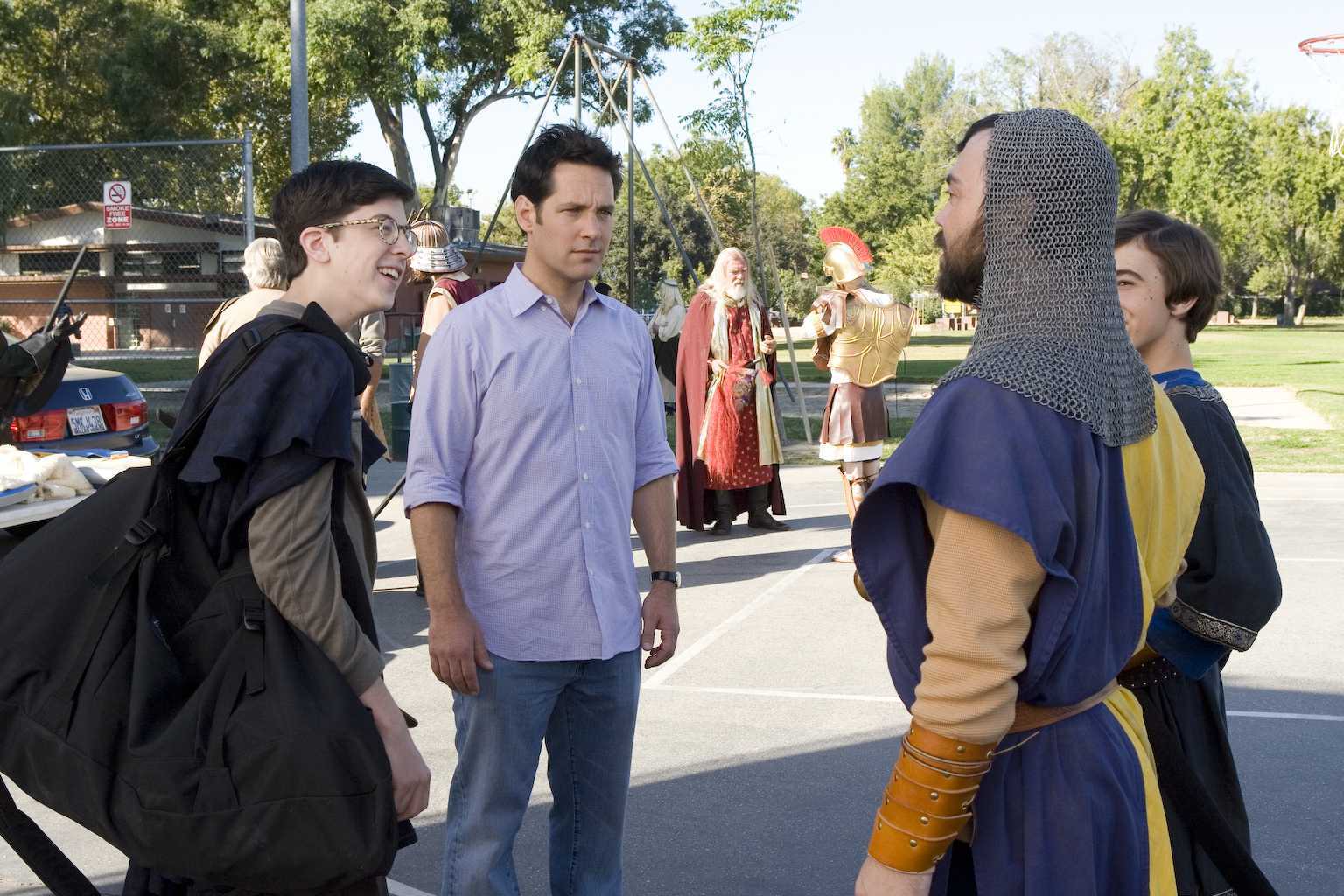
When the movie leans more on the dramatic side, it's surprisingly effective. There's nary a chuckle to be found in the dinner between Danny, Augie, and Augie's mother and stepfather, but it's well-written and believable. The live action roleplaying scenes are also hilarious and impressively choreographed, and while many of the jokes related to them fall along the same general lines it's clear that everyone is having a good time.

Verdict:
Worth a visit.

Toy Story 3


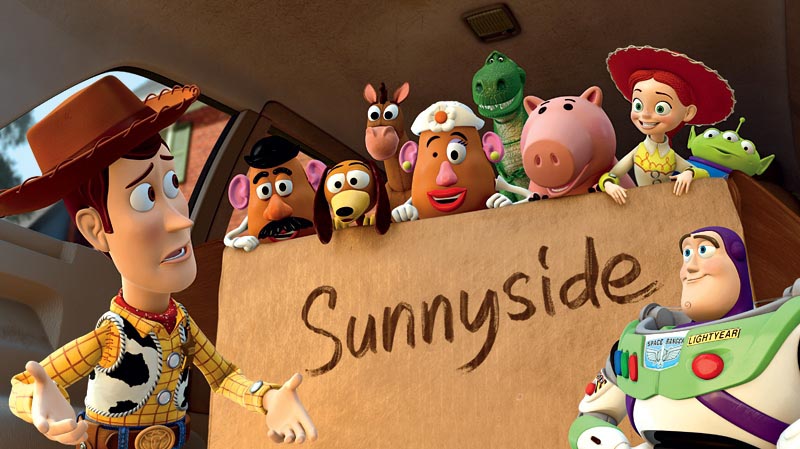
Synopsis: Amid uncertainty over their future as 17-year-old Andy prepares for college, the toys are mistakenly donated to a daycare center.

The bad news first:
Pixar's last few films have been children's films with some pretty serious, more adult-oriented story lines. I've seen some question over whether the studio has taken this too far, allowing their films to slide too much into darker, heartrending themes. They definitely have gone a little more somber in recent years; WALL-E and Up were both more than a little symbolic and dealt with heavier issues than earlier movies. By now, everyone probably knows that they're going to go into a Pixar movie and have tears in their eyes at some point.

Toy Story 3 may have gone a little too dramatic in some areas. There's one scene that I won't spoil, which everyone who has seen the movie will be able to point out, that is incredibly dark for what is ostensibly a children's movie but works amazingly well. By contrast, a shot in which three forgotten toys are standing in a field under a sepia-toned, cloud-scudded sky seems to be trying a little too hard to bring the audience down.

The good stuff:
Toy Story 2 focused mostly on Woody's dilemma between being admired forever by children as a museum piece or staying with Andy but running the risk that his owner will outgrow and abandon him. Though Woody opts to stay with Andy, it's a little bittersweet since he acknowledges that he's just going to have to enjoy the time he has left. Sure enough, Toy Story 3 picks up with Woody and Buzz and all the rest buried in the toy chest. The 11-year gap between Toy Story 2 and Toy Story 3 is quite a jump, and Pixar adjusts accordingly. Even the youngest viewers who saw the first sequel when it came out would be in their early teens now, no doubt thinning out or exiling their own ranks of playthings.

The early trailers seemed to suggest that Andy would simply be punted off in favor of some prolonged silliness at a daycare center. Once it became clear that it was going to delve deeper into the themes of Toy Story 2, my confidence was restored. Despite the underlying serious themes, there's quite a bit to keep you laughing. In particular, the narrative of Andy's playtime at the beginning and Buzz Lightyear accidentally reprogrammed in Spanish are hilarious. The story, as always, keeps you caring about each and every one of the characters from the start to the finish. It yanks your heartstrings pretty hard, but it's not like Disney has never done that before and it's extremely fitting given the plot.


Verdict:
Another winner from Pixar. What did you expect?

Sunday, August 29, 2010

Double Feature Review: The Road and Rampage

I originally meant to do The Road alongside Thunderball, the James Bond movie I saw immediately after it, but I never got around to it. So I'm already bending the rules on this blog feature on my second offering, but I feel putting together two movies which have some similarity is another good way to do things. Rampage and The Road are quite different in their story and the level of appreciation I have for them, but both try to work with relatively simple plots.

The Road


Teaser: A father and son journey through a post-apocalyptic America, struggling to survive in a slowly dying world.

The bad news first: One of the few scenes which I thought didn't work involved the father and son seeing a couple of people getting chased by a group of cannibals in the near distance. In their efforts to get away, they end up having to worry more about several dead trees which choose that moment to topple over, nearly crushing them. I never saw The Happening, one of M. Night Shyamalan's largely panned offerings, but one of the major complaints involved characters fleeing from the wind. The danger of the completely decimated trees falling had already been shown, but when it's inserted as the primary fear over machete-wielding savages it comes off as kind of silly.

A little bit of a nitpick, I know, as is my next minor disappointment. There's something of a running theme in the book where the son is fretting over a little boy they encounter on the road whom the father refuses to take along to protect. It's a pretty important part in the book, and in the movie it's relegated to a single brief scene. The overall theme of the father's general distrust of the world around him and the son's penchant for charity is still apparent, but the scene where he sees the little boy is truncated enough that it seems out of place, perhaps even for viewers who haven't read the book.

The good stuff: Success isn't a done deal when you adapt a Pulitzer Prize winning novel to the screen, but there's a pretty good chance of it. The movie is pretty much a spot-on transfer from one medium to the other, hitting upon just about every emotion and image that Cormac McCarthy originally put to the page.

Stylistically, the film presents what may well be the most terrifying images of a post-apocalyptic world ever imagined. The wider shots of decaying cities have a distinct computer-generated residue on them, but the more intimate shots of abandoned malls and freeways are very well-done. A pall of smoke or stormy clouds hang over every scene, and the images are hammered home once one realizes that movie was mostly filmed at scenes of actual environmental disasters or amid urban blight. The most horrific descriptions in the book are omitted, probably in the interests of limiting the rating to R, but there's still plenty there to show that this isn't your happy-humans-binding kind of apocalypse.

The acting in the film is terrific. The film was shot on the cheap, and the characters are sparse enough that highly respected actors like Robert Redford and Charlize Theron are used for what are fairly minor roles. Most of the story rests of the shoulders of Viggo Mortenson and young actor Kodi Smit-McPhee, and both do a superb job. There are plenty of moments where the helplessness seems to overwhelm the two, and it's heartbreaking to watch. Yet it is balanced out, and more often than not exceeded, by the idea that the human spirit is a tough nut to crack.

Verdict: Best watched when you can have someone to comfort you, but definitely one to check out.

Rampage


Teaser: A sick-of-it-all youth goes on a massive killing spree.

The bad news first: The director of this movie, Uwe Boll, has been widely panned as a hack who can't make a film to save his life. The Nostalgia Critic says it better, of course, in the beginning of his (and Spoony and Linkara's) review of Alone in the Dark. In general, his movies exist more as a target of MST3K style snark, even if Boll himself may consider them to be great works of art. That said, I checked out Rampage because reviewers generally said how surprised they were to like it in spite of the Boll credit.

Perhaps the biggest disappointment in the movie is that there is virtually no reason to sympathize with the main character, shooter Bill Williamson. Rampage bears some similarity to Falling Down, which features a jaded ex-military contractor storming through Los Angeles and unconventionally airing his anger toward convenience store price gouging, construction delays, overpaid plastic surgeons, and a variety of other targets. He destroys a lot of property, but he limits the casualties to the self-defense killing of one neo-Nazi shopkeeper. The audience has plenty of sympathy for him, since he's taking on the multifarious annoyances in society without becoming a truly horrible person, so the line at the end where he's stunned to find out he's "the bad guy" has some resonance with the viewer as well.

By contrast, I can't really see any mentally sound person going ra-ra for Williamson. His friend posts a few YouTube rants about overpopulation and all of the problems it's causing, but Williamson himself doesn't seem to subscribe to this view. He's undoubtedly stressed to the breaking point over an unsatisfactory job and pressure from his parents to move out, but he seems just as motivated to kill dozens of people because the restaurants in the area have rude servers. So while I came away from Falling Down sympathizing to a certain degree with the semi-antagonist and still able to be amused by his rampage, I came away from Rampage thinking, "This guy is a monster" and "Cry me a river, Klebold."

I've never really subscribed to the idea that violence in movies, video games, and so on is a direct cause of massacres like the Columbine High School shooting. Still, the soundtrack and other parts of the movie seem to be playing up Williamson's actions rather than condemning them. Any person in their right mind would be repulsed by the rampage, but it's just a little disconcerting to watch a movie consisting mostly of mass murder and realize that it might well be a favorite in the DVD collection of the next deranged gunman to make the news.

The good stuff: Since Uwe Boll's reputation is failing everything related to movies forever, Rampage is at least properly assembled. Most of the actors do a good job, and the dialogue comes off naturally as well. In terms of eliciting a strong reaction, you can't get a much stronger reaction than the loathing Williamson elicits. The ending is also rather unexpected.

Verdict: It's odd that in his slow improvement, Boll has gone from making easily panned movies to more imperfect but not altogether atrocious movies. There are much more palatable films if you're looking for a straight action flick, however, and rather more humane dramas such as Elephant if you want something specifically related to a shooting spree.

Wednesday, July 28, 2010

Double Feature Review: Boondock Saints II and Inception

Here begins yet another recurring segment, which should remain feasible as long as my "to see" list of movies includes dozens of titles, Netflix keeps getting my money, and rural Maine continues to be boring. I tend to chat with a college friend while watching movies online, and quite a few Friday nights have been spent that way. I guess I could go out and hit the scene, but you know...rural Maine. This segment is quite simple: a two for the price of one movie review where I'll give a quick reaction to some movies I've seen in quick succession, either back to back or within the span of a few days.

The inaugural duo: The Boondock Saints II: All Saints Day, 2009 sequel to cult hit The Boondock Saints, and Inception, the current mind-bending adventure from Christopher Nolan. We'll start with Saturday's entertainment.

The Boondock Saints II


Teaser: The movie came out a decade after the first Boondock Saints, but only eight years have passed when the story begins. The Saints and their father have moved to Ireland to pursue a quiet farming life, but return to Boston when they are framed for the murder of a priest. They pick up a Mexican fighter along the way, as some of our favorite finest from the Boston Police team up with an FBI agent to figure out how to respond to their return.

The bad news first: It takes a solid half-hour for the story to really start. The Boondock Saints ended with the brothers and their father vowing to exterminate crime syndicates in the city and the BPD giving them a little bit of help in their mission. It turns out they can't keep a promise. The final scene marked their final murder, at least until the action starts to pick up. So rather than keeping the Saints in Boston, where a frame-up may well have had more serious consequences, it has to grind its way along with everyone fretting about what will happen when they get to Boston. By comparison, at the half-hour mark of The Boondock Saints we've already gotten quite a bit of character development, a couple of dead Russian mobsters, and the Saints' realization of their cause.

Most of the surviving characters return, but the absence of Willem Dafoe's Paul Smecker is obviously the most noticeable one. Julie Benz plays a protege of his, ie the same character but better-looking in a dress. For some reason, Benz also puts on a Southern accent for the role. I'm sure there are men out there who immediately consider a Southern accent to immediately amplify a woman's sexiness, but it just doesn't seem to fit. Clifton Collins Jr. does a reasonable job with Conner, who the Saints take on as a third member, but the character doesn't seem all that necessary. The first movie made it kind of clear that Daddy Saint was taking the place of the slain Rocco, but due to the stuttering transit issues in the first quarter of the movie the Saints are left with a not-really-necessary vacancy to fill.

Troy Duffy, writer and director of the original movie, returns for the sequel. Unfortunately, he tries to transfer quite a few of the favorite elements from the first film. References to past parts of a series are perfectly OK when done in moderation, but the best sequels take the characters and give them a new situation, resulting in an entirely new story for the audience to love. Boondock Saints II ends up transferring way too many things over, to the point where characters are dredged up from the dead.

The good stuff: After that half-hour plod to get the Saints to Boston and they finally do what they do best, the movie suddenly feels a lot more like the original. A clumsy assassination attempt involving a forklift and a piddling little gun is immediately followed by a hilarious attempt by Detective Greenly (Bob Marley) to do a Smecker-esque forensic investigation with some wholly inadequate music on his iPod. I know I complained about the transfer of too many elements, but the return of the rope in one scene results in a scene which nicely shows the progress the boys are making in vigilantism since their lucky break in a luxurious hotel room.

It's nice to see the relationship between the authorities and the Saints explored a little more. The backstory of the Saints' father is done very well. And I rather enjoyed the ending, and not in a "thank God it's over" kind of way. It pretty much requires a third movie in the series, though. That could easily be a good thing, but it could turn out to be pretty awful as well.

Verdict: It was really flawed, but you can still enjoy it.

And on to Sunday.

Inception


Synopsis: A new technology allows a group of thieves to sneak into the subconscious of people who have been knocked out by roofies or other means in order to steal their ideas. When a client wants to use the technology for "inception" (the planting of an idea) to break up a rival empire, one thief is willing to do it in order to win a return to the United States to see his children. But the memories of his wife and other obstacles threaten not only this goal, but the safety of his fellow mind hackers.

The bad news first: The soundtrack at times competes with the dialogue. Much of the first half of the movie is discussion, and the score seems to be constant even in scenes where it would have been much better for it to quiet down and let the characters talk.

One dream seems just a tad cliche. No, the dreamer doesn't wake up in a high school hallway in his underwear, but the environment is just a little unoriginal. When I saw the trailers for this movie, I thought it gave an excellent sense of anything being possible in a dream through unconventional images like the train barreling down the city street and zero-gravity fights in a hotel hallway. When one trailer informed us that there would be scenes of battles at a remote fortress in the snow, it made me wonder if the dreamer had recently seen The World Is Not Enough or something.

The good: So very much. There's a reason this movie has earned a 9.2 out of 10 average vote out of some 84,000 votes on the Internet Movie Database, ranking it as number three on their list of the top 250 user-rated films.

The trailers have already revealed virtually every action scene in Inception, but they also promised that it would deliver a story with the visuals only serving to complement it. And it does. Christopher Nolan, fresh off the success of The Dark Knight, has written an excellent screenplay with a very original premise. The story is highly complex; the opening scenes immediately start whipping the audience around, revealing a few flashbacks and multi-layered dreams within the opening scene alone, and this structure continues until the end. Yet even when you're in the midst of a dream within a dream within a dream within a dream, you can still trace your way back to reality and know the motivations and reasons for what's going on.

I've seen some mixed reviews about Leonardo DiCaprio's performance, which I'm hoping isn't just continued residual resentment over the Titanic hype 12 years ago. DiCaprio's performance probably won't net him an Oscar nomination, but it kept you caring for the character and his overall situation. Joseph Gordon-Levitt and Ellen Page did quite well in their roles of trying to keep things tethered in some degree of sanity. Michael Caine seems to be quite a big name for a role which comprises some 20 minutes at best, but perhaps that just goes to show that they weren't going to water anything down when it came to the actors.

The visuals are very striking on the big screen and, as I've mentioned, they don't overwhelm you. In fact, I was focused so much on the story that when the train finally did come blasting down the street, it caught me completely by surprise. Even though it was one of the more iconic images in the trailer, I hadn't been waiting impatiently for it to show up.

And finally, there's the last scene. Not to give anything away, but it couldn't have been better.

Verdict: Go see it.