Showing posts with label weird history. Show all posts

Saturday, July 16, 2016

I Make Fun of State Quarters: Georgia

I'm going to start by playing the free association game. Let's see some of the terms I come up with when I think of Georgia:

Peaches
Millions of peaches
Peaches for me
Millions of peaches
Peaches for free

OK, I'm getting a little sidetracked. And the Presidents of the United States of America aren't even from Georgia, they're from Seattle. Let's try this again:

Peaches
Jimmy Carter
The Walking Dead
CNN
Sherman's March to the Sea
Gone With the Wind
Stone Mountain
Squidbillies

So when it comes to putting something on the state quarter, what should Georgia go with? There's the Union Army's path of utter destruction through the middle of the state, and the book about the spoiled Southern belle it inspired. And that giant mountain carving of the military officers of an army for a country that no one ever recognized. And the President who was attacked by a rabbit. And TV shows featuring redneck cephalopods and zombies.

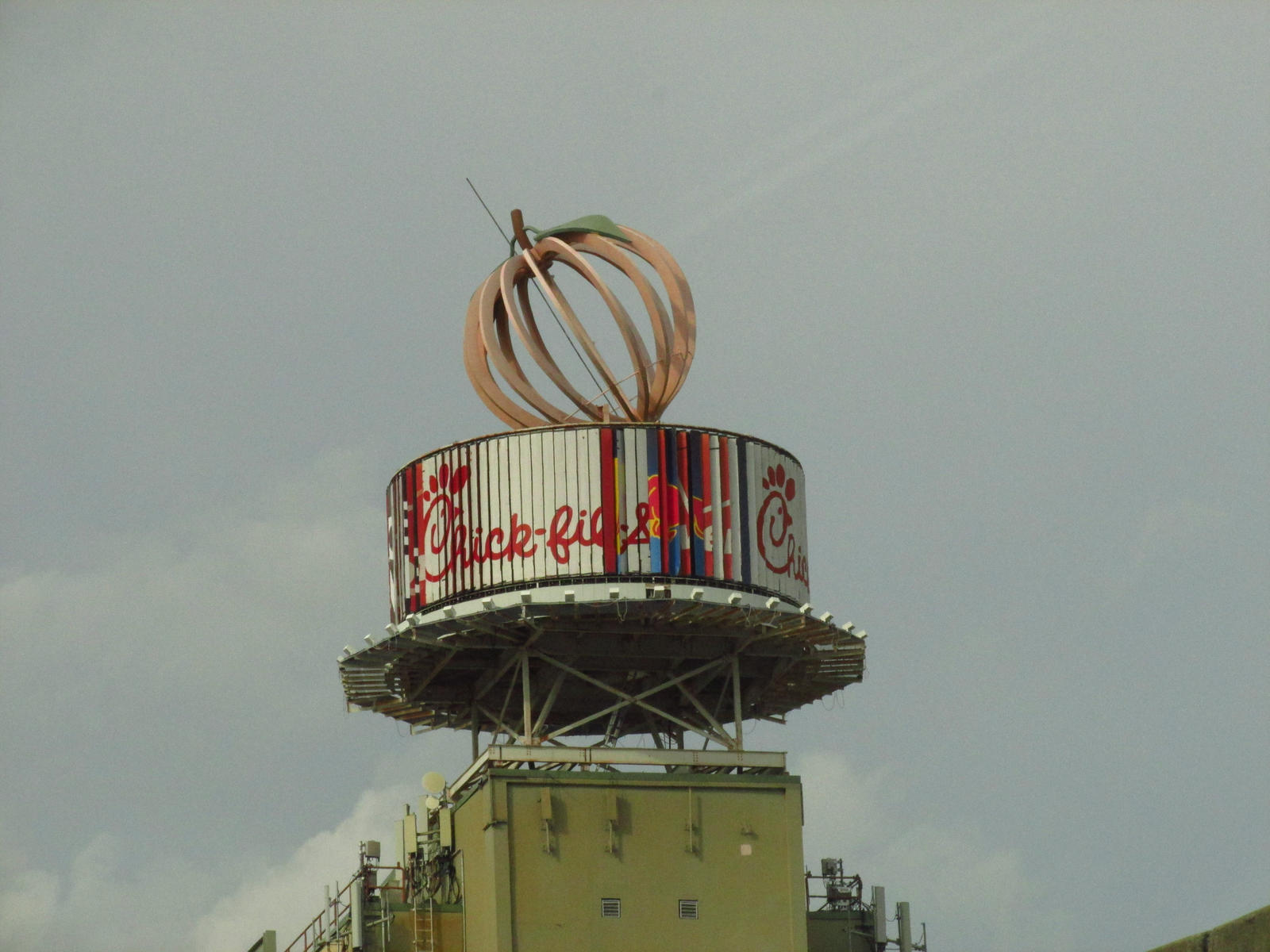
Hmm, what could the Peach State possibly choose to be on its


Yeah, it's a peach. Right smack in the middle of the state, as if Roald Dahl's gigantic magically enhanced fruit had crashed down in the Empire State of the South instead of the Empire State Building and squashed millions of people beneath its fuzzy flesh. Or maybe President Frank Underwood stole a bunch of money from FEMA and built a Peachoid that's visible from space.

Peaches have been part of Georgia agriculture for a long time, but didn't become especially prevalent until after slavery was abolished. After everyone whined a bit about the "Lost Cause" and having to pay people to work, they opted for something that could be grown without quite so much manpower. Despite its designation as the Peach State, Georgia is actually fourth in the United States in peach production and recently has transitioned to blueberries as a more prevalent crop. But Georgia is no doubt going to cling to their designation on the argument that their peach varieties taste the best, dagnabbit.

"And our peach sculpture is way uglier than the Peachoid, too!" (Source)

Georgia's state quarter also includes a few other state symbols, but not so many that it makes it seem ridiculously crowded (ahem, Arkansas). There are live oak sprigs on the edges and a banner featuring the state's motto, "Wisdom, Justice, Moderation."

Overall, it's a perfectly functional, perfectly boring state quarter. However, it's unique in that there was a bit of controversy concerning the shape of the state. Some of the initial designs had the state shaped correctly, while others lopped a bit off the upper left corner. Eagle-eyed observers noted that the final design opted to circumcise Georgia, neatly removing Dade County.

This may have been a nod to the county's odd history. Dade was supposedly "sick and tard of Georgia's shillyin' and shallyin'" when the southern states were deciding whether to secede or not, so they opted to secede on their own from both the United States and Georgia. The "Free State of Dade" continued to proclaim its autonomy until World War II made insistence that you weren't part of the country a bit of a bad idea, and the county formally rejoined the U.S. on Independence Day in 1945.

The Dade County website insists that it never went rogue and that it's all a legend, probably because being among the most vociferous proponents of leaving the country to preserve slavery isn't the best legacy to celebrate. There have been suggestions that the quarter's exclusion of Dade County was a simple mistake, with the artist perhaps working off a map that didn't include this section of the state.

Wikipedia includes a section on the "controversy" surrounding the design. I haven't seen much about bruised feelings in the most northwestern section of Georgia over the snub. If they were really offended, maybe they should have thought twice in 1982 before raising the proposal of seceding from Georgia and joining Tennessee.

And Dade County knows what I like in scenery, so I'll leave them be (Source)

Monday, November 3, 2014

I Make Fun of State Quarters: Delaware

I feel a little bad making fun of Delaware. I mean, isn't the poor state a punchline already?


Yes. Yes it is.

Still, I must persevere.

It's not like there's any reason to dislike Delaware. I'm sure it's full of wonderful people and quaint little downtown areas and affable grinning Vice Presidents. But it just seems so...plain. Something tells me there aren't too many newlyweds saying, "Hey honey, lets get away to scenic Delaware and climb to the Ebright Azimuth. We'll be higher up than anyone in the entire state!"

And when Mom and Pop load up the station wagon for a family vacation, are they really going to say to the kids, "Come on, children! We're going to visit Felton. We can see the Thomas B. Coursey House. He got the right to stock a mill pond with bass carp in 1883 and tell other people they couldn't fish there. They call their townships "hundreds," and Felton is in South Murderkill Hundred. Doesn't that sound nice??"

Behold, majestic Felton. (Source)

It's almost too much to handle, all these sights and sounds. How can one simple state quarter hold all the excitement that Delaware has to offer?


Well, that does pack it in pretty well. Everyone loves a horsey.

Wondering why Delaware was the place that kicked off the state quarter program instead of one of the states that sits at the cool table, like Massachusetts or California? It's because it was the first of the original 13 colonies to ratify the Constitution, giving it the honor of being the first state in the Union. Thus the big "First State" label on it like some 14-year-old's YouTube comment. There were other colonies established before Delaware, of course, but it still gets to brag about how it was a state before the United States existed.

So now is the time to tell the story of Yankee Doodle, riding through a quarter on a pony. No wait, that isn't it. It's Paul Revere, right? He's heading off to say that the British are coming. Except that was in Boston, not in Delaware. Um...who is this guy again?


Ah yes, Caesar Rodney. Delaware chooses a truly interesting fellow known for being a sheriff, register of wills, recorder of deeds, clerk of the Orphan's Court, and justice of the peace. He's held more public offices than anyone else in Delaware. Hooray for competent county-level politicians?

Actually, Rodney is best known for riding 80 miles through a thunderstorm while ill to get from Dover to Philadelphia. This was in July of 1776, and he made the trip after finding out that Delaware was split on whether or not to go along with the Declaration of Independence. Although his constituents were chiefly Loyalist, Rodney cast the deciding vote in favor of independence.

Delaware might want to forget that his constituency rewarded this patriot for his bravery by throwing him out on his ass. Once it became clear that he had supported the Declaration of Independence, voters in Kent County opted not to include him in the state's constitutional convention or general assembly. They did come around again in 1778, electing Rodney to a position that somehow manages to sound both impressive and embarrassing: "President of Delaware."

It also helps that the quarter's design keeps Rodney's face tiny enough that you can't really make out any detail. No one painted a portrait of Rodney when he was alive, since his face was ravaged by cancer. John Adams described him as having a face "not much bigger than a large apple," perhaps because Adams didn't realize that Rodney wore a facial covering to hide the disfigurement.

Pictured: Caesar Rodney (Source)

All things considered, Rodney is a good choice for the quarter design. He put country before self, and he achieved greatness despite his young age and physical ailments. Maybe some people were disappointed that the quarter didn't have the Delaware Memorial Bridge or something, but it never hurt anyone to pick up a book or do a bit of Googling and learn an interesting story.

Besides, it's certainly better than the alternate designs. Like this one:


That would be Lady Liberty blazing a torch into the future and boldly proclaiming, "Behold! A new nation is born, and the first member of this glorious country shall be this odd misshapen lump of a state!" And then Lady Liberty would presumably pause for a few seconds and say, "Um...Aubrey Plaza is going to be born here in another 200 years and change. That's something, right?"

And even that's preferable to this finalist:


That design recognizes the fact that Delaware has a chicken breed named after it. Had the Mint gone with this design, we'd all have to sarcastically thank Delaware for starting out the state quarter series by showing us their cock.

Tuesday, April 22, 2014

I Make Fun of State Quarters: Connecticut

All right, back on track after that alphabetical snafu.

A long, long time from now, whenever I get up to the N states in the alphabet, I'm going to have to make fun of New Hampshire for choosing a state symbol that unexpectedly disappeared three years after the state's quarter was issued. For now, I'll have to content myself with making fun of Connecticut for selecting a symbol that vanished 143 years before the state quarter came into being.


Behold, a tree! It's about as exciting as Connecticut gets.

All right, full disclosure: I live in Connecticut, and I have for three-and-a-half years. Its politics are ridiculous, its mountains are hills, and of all the New England states it's the one with the most obvious identity crisis. Half the state roots for the New York Yankees, for God's sake. But I've still met some wonderful people here, there actually are quite a few lovely attractions, and I can't help but marvel at how devoted people are to local history.

So it's no surprise that Connecticut opted for the historic angle in choosing the Charter Oak for its state symbol. Though there's no denying that the fellow who designed the Connecticut quarter, one T. James Ferrell, did a bit of airbrushing when he etched out this portrayal of the Hartford tree. Take a look at the sexy flowing branches of the final design, then compare them to this alternate proposal:


Yeesh. Looks like the Charter Oak was grown from a scion of the Ugly Tree and replicated every branch on the way up.

Most portrayals of the oak show it as a scraggly runt, so apparently the above design is closer to the truth. But it's nothing that will win any beauty contests. They would run off more than a billion of these coins, so clearly they couldn't make it some gnarled old maid. They needed to make it the Summer Glau of trees.

Welcome back to my blog references, Ms. Glau! (Source)

So what's the story with the Charter Oak, anyway? Well, according to the lore, the 1662 charter granted to Connecticut by Charles II allowed it a great deal of autonomy within the British empire. When James II took over the throne, he looked to put an end to such tomfoolery and sent an emissary to demand the surrender of Connecticut's charter. Everyone sat together at the table when lo, the candles were snuffed! Captain James Wadsworth spirited the charter away to hide in a nook in the one tree on a nearby Hartford hill. Somehow, the British failed to find it.

So there you have it. Connecticut's greatest accomplishment wasn't Mark Twain, it was a magic vanishing act. Granted, the Charter Oak is a more interesting story than the one that led to the "Constitution State" nickname, namely that the Fundamental Orders of 1638-39 might be considered the first constitution in the American continent. There's also the "Nutmeg State" nickname, but Connecticut can't really be too proud of the idea that its citizens of yore were clever enough to sell counterfeit wooden nutmegs to gullible bumpkins.

I've learned a fair amount about New London history in my time here, namely that the city was burned down by both Benedict Arnold and a hurricane and that a harebrained scheme to steal a submarine included the possibility of obliterating the place with a nuclear weapon. If I'd arrived here way back before the quarter design was finalized, I might have argued for it to portray the story of how an early Revolutionary War mission raided a British armory in the Bahamas to obtain gunpowder and munitions for the colonials before taking the booty to New London. It's pretty awesome that part of the city's history is pretty much the same as one portion of the rebooted Battlestar Galactica.

Exactly like this, but in Nassau. (Source)

It would be nice if the Charter Oak was still standing but alas, it was blown over in an 1856 storm and survives only in a few pieces of furniture in the state legislature. But both the storm and the power outage of the original Charter Oak heist are still commemorated to this day. Whenever a storm is powerful enough to knock out electricity, Connecticut Light and Power takes a symbolic two weeks to restore it.

Thursday, December 16, 2010

Double Feature Review: Fast Food Nation and Joyeux Noel

Fast Food Nation


Synopsis: A critique of the fast food industry presented through the loosely interconnected stories of a marketing executive, a teenage counter girl, and a group of undocumented workers in a meatpacking plant.

The bad news first:
The movie is based on the book of the same name by Eric Schlosser, an investigative journalist who wrote a very well-received account of the cost you actually pay for getting a burger and fries in under five minutes. By transferring it to the screen as a fictional story, however, the whole premise is kind of cheapened. A few of the actors are rather well-known, and Burger King and McDonald's are clearly mentioned while the story focuses on a third, fictional major burger chain (a lame knockoff of McDonald's called Mickey's); it creates more than a bit of a disconnect, which serves to blunt the message of the film.

As a whole, the movie is really only able to focus on a few issues: the exploitation of illegal immigrants in dangerous working conditions, the problems of ensuring the quality of beef, and the challenges facing working youth. Other issues related to the industry, such as environmental effects in South America, are never brought up. The focus on the meatpacking plant workers works pretty well, but it suffers from the same problem as the other storylines: the fact that none of these issues can really be blamed on fast food. Aren't there a lot of industries that exploit undocumented workers? Is getting a steak at a nice restaurant any better or worse than getting a burger that was also churned out of a slaughterhouse? Don't all teens hate their jobs?

Promising hints show up here and there, including a few kitchen workers contemplating whether they'll be the latest in a recent series of holdups and determining that maybe they should rob the restaurant. That would have been a great story to follow...and it never materializes. Several other meandering stories or premises also fall apart before reaching a satisfying conclusion.

Finally, it can be a little wordy (or didactic, as the New York Times nicely puts it). The problem here is that there are plenty of instances when you're well aware of how long people are blathering on about some hot-topic issue. It's well-written and realistic enough, but there are times when it starts to grate. Especially in the bullshit sessions of a college common room, whose scenes are made doubly annoying because some casting director thought Avril Lavigne could act.

The good stuff:
As has been mentioned, the story featuring the illegal Mexican immigrants and their experience in the meatpacking industry is the strongest of the bunch. I'm sure I could go onto a message board right now and find someone screaming right-winger about how illegal immigrants don't deserve sympathy, and some left-winger screaming right back at him, but the movie itself never gets tangled up in the numerous issues surrounding this topic. It just shows what can happen behind closed doors.

For the most part, the actors do a good job. Some scenes are also quite enjoyable to watch, such as the discussions between the girl and her mother and especially the later conversations between the girl and her uncle. And the last scene showing real footage of cows being killed and butchered, though again having the effect of making you question eating meat rather than eating fast food, is about as visceral and effective as it can be.

Verdict:
Here's an idea for when you adapt a book by an investigative journalist: make it a friggin' documentary instead of a fictional movie that tries to be one. It's a little tougher to find an audience, but if you do a good enough job they will come. Consider Super Size Me, an excellent documentary that lambasted fast food in general and McDonald's in particular for contributing to American obesity. It made $30 million. Fast Food Nation made one-fifteenth of that.

Joyeux Noel


Synopsis: Scottish, French, and German soldiers hold an impromptu truce on Christmas Day in 1914.

The bad news first:
There's...really not a whole lot. The Christmas Day truces actually happened, with varying degrees of intensity in the fraternization between soldiers. One negative review I came across whined that the movie should have made it clearer that this happened all alone the Western Front, not just in this one unit; another more positive one said it would seem hokey if it weren't for the fact that it actually happened. If those are the only complaints you can come up with, I'd say you just watched a pretty good movie.

The good stuff:
This is one of the more inspiring stories from World War I, and the movie does it justice. The scene in which the opposing soldiers slowly but surely make friendly gestures across no man's land and finally walk out among the debris and bodies to have a few moments of peace is especially heartwarming. It's equally as painful to watch as they slowly restart the conflict, despite the obvious comradery they form in the short time they spend together.

World War I was one of the most pointless fights in history, if not the most pointless one given the much more malignant bloodshed that followed in Europe 21 years after the armistice. The movie drops a few anvils in pointing out this fact, including an opening showing schoolchildren from the three countries reciting hateful speeches against their enemies and a priest reluctantly giving a sermon about how it's God's will that the Scots soldiers kill the Germans. Even if it's heavy-handed at times, it's a point well worth making. There are also some more subtle moments, such as a German soldier saying he enjoyed the brief peace even though he doesn't celebrate Christmas since he's Jewish. We know that even if he survives the fight to return to Germany, it will only be a matter of years before he's persecuted as an enemy of the state.


Verdict:
You should definitely see it. It even works as a non-traditional sort of Christmas movie.

Saturday, April 10, 2010

I Make Fun of State Quarters: Alabama Loves Socialists

From what I can gather, the state quarters program which began in 1999 and dragged on for another decade. Meaning if you didn't care much for the Bush Administration, you could at least console yourself with the periodic introduction of a shiny new 25-cent piece showing some idyllic depiction of what the state is best known for. Everyone thought these were quite nice, and it was a successful enough initiative of the Mint that they'll be rolling out another set of quarters featuring Guam and Puerto Rico and other such U.S. protectorates.

I don't have any real gripes with the state quarters, but I figure this will be a fun enough 50-part series to do, with the possibility for expansion to the protectorates later on. And it just so happens that the quarter design that inspired this idea is the first, alphabetically anyway, of the states.

ALABAMA

Helen Keller sits around and takes credit for Louis Braille's work.

This quarter was released on March 17 of 2003, all of two days before the U.S. invasion of Iraq. Designed by Norman E. Nemeth, the coin features Ms. Keller flanked by the magnolia-laden branches of an Alabama long leaf pine. The centerpiece, of course, is Hellen Keller and the little Braille nod in her direction. Everyone knows who Keller is. What she did is less certain. She was blind, deaf, and dumb, meaning she lived a rather scary-sounding existence based on smell and touch until she gained the ability to speak. And then...the miracle worker told her what water was? I'm not sure. Well she must have been from Alabama, anyway.

All right, here's what the wonderful Wikipedia factory has to say. Keller was born in 1880, lost the ability to see and hear due to an illness at age one-and-a-half, and was just starting to communicate when that happened...and learning to speak is kind of hard when you can't see or hear anyone. Her family wanted to give her a fighting shot at education, and with the help of her teacher, Anne Sullivan, Keller went on to learn how to speak and alternated between schools for the blind and deaf. Then she went on to graduate from Radcliffe College in 1904, becoming the first deaf-blind person to get a Bachelor of Arts degree.

So there you have it. An inspiring story of family love and an inspiring teacher and a young woman overcoming the odds. She's certainly a good person to put on the quarter, and probably one of the better choices since the list of notable Alabamans seems to mostly feature sports stars. Rosa Parks would have been another good choice, but she was still alive when Alabama's turn came up and the Mint seems to have a practice of not putting living people on money. Though that didn't stop the more devoted Reagan lovers from demanding that the then-aging ex-President take FDR's place on the dime, since the bullet that hit Reagan during his assassination attempt was dime-shaped and all that crummy Roosevelt did was start the March of Dimes.


The designer of this Reagan was next seen making a fevered dash for Devil's Tower.

But I digress, and the Reagan currency debate can be on admittedly more solid ground now that he's passed away. Though from what I hear, some congressmen probably won't stop until he's on every piece of currency. Ever. IN THE WORLD.

So what did Ms. Keller go on to, then? Well, she got married a year after graduating college, wrote 12 books, got a dog in Japan named Kamikaze-go, received the Presidential Medal of Freedom, co-founded an institution in her name, helped start the ACLU, joined the Socialist Party-

A-whaaaaaat?
Yes, Helen Keller joined the Socialist Party as well as the International Workers of the World, spoke on the topic of workers' rights quite a bit, and campaigned for Socialist presidential candidate Eugene V. Debs. This was during that period in U.S. history when the Socialists actually had some clout, but still weren't received all that well. Keller said people who had once paid her compliments now played up her disabilities. In one amusing case, she responded to a newspaper that claimed the Socialists had used her disabilities to trick her into supporting their cause by saying, "There's a chance for satirical comment on the phrase, 'the exploitation of poor Helen Keller.' But I will refrain, simply saying that I do not like the hypocritical sympathy of such a paper as the Common Cause, but I am glad if it knows what the word 'exploitation' means."

"Shut up, Helen, there's teabaggers about!"

To wrap up the Helen Keller story: well, she died. In 1968, in Connecticut. She spent a lot of time raising funds for the American Foundation for the Blind, and was made the subject of several plays and movies. Which, of course, focused mainly on how she learned about water from Anne Sullivan rather than her Socialist and pacifist tendencies.

So it seems this has turned into more of a look into Helen Keller's life than a major critique of the Alabama state quarter. I guess I'll close by saying this: Alabama, those tree branches are quite lovely, and you have a Socialist on your quarter. Which is fine, it's a free country and all. But the next time I see a Tea Party rally down that way, they'd better be demanding a redesign to put Rosa Parks on the coin or else their complaints about socialism are going to ring kind of hollow.