Showing posts with label greatest thing of anything. Show all posts

Monday, February 16, 2015

Greatest Thing of Anything: The Lost Tribe

Combine a group of bumbling caveman, a scheming backstabber, and leadership responsibilities. What do you get? An excellent and memorable video game, as it turns out.


The Lost Tribe, developed by Lawrence Productions, was released as a PC game in 1992. As a reviewer on Moby Games notes, it has a bit in common with The Oregon Trail. Like that classic game, The Lost Tribe makes the player responsible for safely leading a group of people on a long journey to a new home. Except in this game, you're in charge of two dozen cavemen instead of a smattering of Missourians.

The game opens with the cataclysmic eruption of a volcano. The disaster kills your tribe's chief and best hunters, leaving a group of unskilled survivors homeless. Your only hope is to make the trek to another volcanic paradise, the home of your ancestors. You have been selected as the new chief. It's up to you to plot a course to your new home, keep the tribe happy and fed, and deal with whatever crises might arise.


Looking out for the welfare of 24 people isn't exactly an easy task, and the game works to keep you on your toes. There are a lot of moving parts to keep track of as you oversee what the tribe will do each day.

First and foremost is food. Each day, you have to decide whether the tribe will get a full meal, skimpier rations, or no grub at all. Much like the oft-decried real world element of The Oregon Trail that lets you slaughter as many buffalo as you want but only take 200 pounds back to your wagon, The Lost Tribe limits the amount of food a person can carry to three shares apiece. Hunting and gathering is an everyday task, meaning you have to pay attention to the attributes of your area when deciding what animal to go after. Enough unsuccessful hunts and you'll have to assign people half rations or send them to bed without dinner, increasing the chance that they'll become unhappy.

Time is at a premium in the game, but any effort you can make toward improving your tribe's hunting skills will be rewarded. You can skip hunting if you have enough food, passing the day by having the tribe practice with their spears; the more you practice, the more experienced the tribe will get and the more likely they'll be to succeed on a hunt.


A troublesome tribe member, fittingly named Burgle, is waiting for any opportunity to usurp your position. If people get too unhappy or lack enough confidence in your leadership, you lose the game and he takes over. Though the game's educational component is limited to an encyclopedia about various animals and primitive cultures and such, it helps to browse it to find out where you're most likely to find certain prey. Go hunting for bears in the plains and Burgle will convince part of the tribe to hunt with him for bison instead; if he's successful, it's that much more of a blow to your leadership.

There's also the disquieting fact that you're setting out just a few months before winter. Once this season starts, it becomes harder to find animals to hunt or plants to gather.


As if all this wasn't enough, you'll also have your leadership tested constantly with random daily events. These range from serious (people growing weak from walking through the blistering heat) to silly (deciding who to vote for in the tribe's election for a "drain commissioner"). Many of these situations give you great advantages, including enormous quantities of food, if you answer correctly. If you make the wrong decision, you might lose supplies or even suffer the loss of a tribe member.

Getting to your new home is the only way to win, and there are plenty of ways to lose. Burgle might take over as chief and banish you. The tribe will abandon you if too many people die along the way. And if you keep the tribe's confidence but don't get to your new home before winter sets in, you're treated to a haunting end of game screen showing the tribe frozen in their steps and buried in snow.

The game works to keep the tone light and amusing, even if it does periodically remind you that you're figuratively responsible for the lives of a large group of people. A con man named Piltdown appears wearing fur shorts and a cheesy tie. The stick figure animations showing how the hunt went usually feature a humorous sequence, even if a member of the tribe is killed (one shows a hunter throwing a spear into a tunnel-like cave, only to be run over by a train that rockets out with a bear in the tender). There's even some suggestion that this isn't exactly taking place in a prehistoric era; in one scenario, the tribe comes upon the rusting hulk of a car and wonders what to do with it.

Incremental increases in difficulty keep the game interesting. Higher levels have little if any of the map filled in, forcing you to explore and look out for signs left by your ancestors to find your way to your destination. They'll also start you off with less food, unhappier tribe members, and fewer days until winter. If you can overcome all of the challenges, you'll be greeted with a triumphant victory screen and some classical music rendered in MIDI.


The Lost Tribe isn't perfect, of course. Though modern day reviews have been positive, there are also complaints about how much your leadership relies on clicking the mouse. You're only assigning tribe members to do things, so you'll be disappointed if you expect to take an active role in bringing down a boar.

Still, this game is an excellent challenge and well worth a play. Check it out over at Abandonia.

Saturday, October 4, 2014

Greatest Thing of Anything: Elbow, Live in Concert

Some time ago, I mentioned how the band Elbow has never really caught on in the United States despite the quality of their music, their popularity in their native England, and the use of one of their most popular singles ("Grounds for Divorce") in a variety of American commercials, movie trailers, and video games.

So imagine my surprise when I finally heard Guy Garvey on my beloved WEQX. Elbow had just released a new album, "The Takeoff and Landing of Everything," with a single entitled "New York Morning." And with the new album, they were doing a new tour through the United States. What better time to catch them in concert? So I took a mini-vacation with my fiance to Philadelphia in May to take advantage of the opportunity. 

They were probably the best live performers I've ever seen.

OK, maybe they didn't play as much from "Leaders of the Free World" as I hoped for. But it was still an awesome experience, thanks in part to the Philadelphia atmosphere itself. From the Penn's View Hotel to the delicious meal at the Cuba Libre restaurant to the historic significance of strolling past Independence Hall and Benjamin Franklin's grave, there was never an unpleasant moment.

The concert took place in The Electric Factory, a warehouse turned concert venue a few blocks away from Market Street. I was worried at first that the small cluster of fans that showed up in time for the opening act by John Grant would be the only people who attended, but the venue slowly but surely filled up. Whether they were die-hard fans or people who were curious to check out a show, whether they came from around the corner or hundreds of miles away, the concertgoers made it a full house.


When Elbow took the stage, they did so in a swelling hurricane of instrumental music. When you see a group live for the first time, it's always hard to tell if the band you paid to see is going to prove why they got a record contract in the first place or if they're going to disappoint you by revealing that the real talent behind the band is whoever digitally removes the suck in post. The opening left no doubt that Elbow knows their way around their instruments, and when the stage lights revealed a pair of violinists to complement the tune you could practically feel the awe in the entire assembled body.

Credit has to be given to The Electric Factory, which either has an Elbow fan among its event coordinators or does plenty of research ahead of time in order to add a little extra flavor to the show. The simple but powerful notes of "The Bones of You" were enhanced by perfectly timed strobe flashes from the stage lights. Later, with a bit of a wink, the lights were toned down to little more than a sparkling disco ball for a performance of "Mirrorball."

No concert by Elbow would be complete without a performance of "Grounds for Divorce," and Garvey took delight in teasing the crowd by saying how well the prior cities in the tour had done in participating in the song, goading Philadelphia to try to do better. The Philly crowd performed exceptionally, I have to say. The first line of the song was followed by an absolutely pitch perfect "WHOA-OH-OH-OH-OH-oh-oh-oh-oh-oh-oh-oh-OH" response. Later in the song, the band even kept the audience going for a few extra choruses before Pete Turner dropped the appropriately lung-piercing bass line.

I was surprised to learn that Elbow has been together since 1997; since 1990 if you go back to how Garvey and Turner met when they were teenagers and the band grew from there. It was even more amazing to find out that no band members have departed since the full group assembled. Though Garvey might be considered the face of the band, he doesn't let it go to his head. At the Philly show, he recognized each member as well as the guest violinists. This article in the New York Times delves a bit more into how the band has stayed together as a unit for so long.

The crowd wasn't going to let Elbow go without an encore. A sustained applause brought them out again to play "Lippy Kids" and "One Day Like This." After hearing some of the band's more melancholy songs, like "The Night Will Always Win" and "My Sad Captains," it was nice of them to send us out on a more upbeat note. The finale of "One Day Like This" was especially moving, as the band again made use of numerous pairs of willing lungs to assist with the chorus and make everyone feel all right.

I hope to see you again someday, Elbow, so I might raise a glass to you. Especially if I wind up in England, because I can raise you a glass of your own honest to God beer.


Don't miss a few other great reviews of this show at The Electric Factory: this one from That Music Mag and this other one from The Swollen Fox.

Sunday, April 13, 2014

Greatest Thing of Anything: Cafe Nomad

I credit - or blame - my love of coffee entirely on a corner shop in rural Maine.


Somehow, I made it through my late teens and early 20s without developing much of a taste for the stuff. I never needed it to get through a college all-nighter or hangover, or as a morning pick-me-up. It wasn't until Cafe Nomad opened its doors that I really got to appreciate a good brew and, perhaps more importantly, the coffeehouse atmosphere.

Part of the reason the cafe appealed to me so much was, quite simply, the lack of businesses in Norway, Maine, that really had any appeal. It's not to denigrate Books N Things, the excellent bookstore across the street from where I lived for three-and-a-half years, or the Maine Bookhouse, which was packed with used and rare volumes. But they were about it for local attractions at the time. The rest of the main drag seemed to be an odd mix of rooming houses, lawyers, accountants, and "baubles 'n crap" type thrift stores.

When I first moved to Maine, I lived a short walk away from a brightly colored corner building where Cafe Nomad would soon be located. Signs in the large picture windows fronting Main Street announced the imminent arrival of the business, though the predecessor in my job warned that the promise had been up for months. She warned me not to get my hopes up.

But as it turned out, the promise was genuine and the cafe would open its doors not long after. The owners had been taking a cautious approach, buying the building and taking their time to renovate the interior. By the time it was complete, it boasted a central kitchen space, a brightly lit sitting area overlooking a small stream, and a library of titles belying owner Scott Berk's adventurous and globetrotting lifestyle. It was well worth the wait.


Cafe Nomad soon became a regular Saturday destination for me, typically in the bitterly cold winters but occasionally in summer as well. I would bring along a good book, or take my laptop to be the typical (or, for rural Maine, atypical) coffeehouse writer. I wasn't the only one who found the cafe to be a welcoming spot. Business took off right away, and in its first year the Oxford Hills Chamber of Commerce gave them an award for a valuable newcomer business. And indeed, it was a tried and true model in a new market; before Cafe Nomad, the nearest place to get a coffee and relax was 25 miles away.

They have enormous mugs, and if you were sitting in you got one free refill. They get their joe from Carrabassett Coffee, which is based in northern Maine, and most of the blends are pretty strong. I joked that you needed to add cream and sugar to make it black.


And the food is pretty amazing, too. Soft, fluffy pancakes are a weekend treat that comes with real maple syrup. The chef always seemed to be experimenting with new sandwich specials, so there was usually some delicious option to tempt you.

A couple of years ago, I took a vacation to see some old friends in Maine. They're scattered in a few different places, but I spent the longest time in the Oxford Hills. Going back to Cafe Nomad was a sweet reunion. Quite literally. I got a maple oat scone with breakfast one day, and it was one of the best things I've ever tasted.

Cafe Nomad was starting to host a regular wine tasting by the time I left Maine, and it looks like the place has been successful enough to add more hours and a dinner menu. It deserves all the recognition it gets. The business provided a warm, inviting spot for visitors and locals alike. In some way, I think it helped kick off a wider transformation of Main Street in Norway. Other start-ups never caught on (I could never understand why someone would think their particular Baubles 'N Crap would take off when so many others had failed before) but the Cafe Nomad was followed with more innovative places like a bike and ski shop, games store, and fiber studio.

New London has three coffee houses and a few more cafes with delicious food and bottomless cups of coffee. But I'll always remember Cafe Nomad fondly, and they can count on a customer whenever I pay a visit to western Maine.

Friday, July 13, 2012

Greatest Thing Of Anything: The Book Barn

When I worked in Maine, I wound up renting an apartment right across the street from a bookstore. It was something of a catch-all place. There were plenty of new books on the first floor, along with local titles, magazines, locally baked doughnuts, stuffed animals, and children's toys. The basement was stuffed with used books, and the paperbacks there were yours for 50 cents each. I'd usually make it a point to stop in during the weekend and see what was available.

I've usually got a couple of books that I'm reading at any given time, and when I moved to Connecticut one of the first things I did was get a library card. When it comes to purchasing books, however, New London is lacking. A couple is trying to raise money to open one up, but that's a work in progress and it only started recently. When I arrived in 2010, it wasn't long before I missed living so close to a bookstore and I asked around to find another one.

The first recommendation I got, without hesitation, was The Book Barn.

(bookbarnniantic.com)

I'm just realizing that this is the second entry I've done about a barn business in the past couple of months, but believe me, they're both awesome. It's always discouraging to hear about the challenges bookstores are going through as people start to rely more on electronic readers, but The Book Barn has bucked that trend. It opened in 1981, and since then it has expanded to acquire more real estate in the touristy coastal town of Niantic. Aside from the original location, located on the outskirts of downtown, there are two related shops right on the main drag. The stores are open 12 hours a day for every day of the year except Thanksgiving and Christmas.

The titular barn site has the majority of titles, but quite a few of the books are spread across the site in sheds. The cheaper paperbacks tend to be neatly packed into wagons parked outside these places. If you're in the mood for a game, there's also a giant chess set and a basketball hoop.

bookbarnniantic.com

It's always good for bookstores to have a unique character, so here are some of the things that stand out the most about The Book Barn. There are a bunch of cats, mostly friendly, roaming the property and they have a guide to identify who's who. A couple of goats have their own enclosure as well. Most books go for four or five dollars, with some of the older or more plentiful paperbacks priced at a buck each. Visitors are welcome to free coffee, mini donuts, cookies, and cheese crackers, with the chiding caveat that they're for all guests so don't be greedy. The section on Napoleon is labeled "That pestiferous little Corsican." The impulse buy shelf includes things like Team of Rivals (and yes, I did snatch that up right away). When they purchase books, the volumes spend some time in a shed called "Ellis Island" where people can peruse them to get a first shot at purchase before they're organized in the correct sections.

Evinrude hangs out by the register (bookbarnniantic.com)

The business describes itself as having a web presence (it has a detailed website, after all) but it doesn't have any aspects of e-commerce about it. You're not going to be able to make any e-reader purchases there, and you're not going to be able to search the collection of half a million titles and buy books online. But they assure you that if you're looking for a particular book, the staff will easily be able to help you.

And you can find some pretty excellent things just by browsing a collection as big as this one. I discovered one specific title I was looking for, on a group of World War I pilots from Yale University, perched atop a tall bookcase about military aviation. Stopping into Book Barn Downtown not long after seeing the biopic Chaplin, I couldn't resist buying a copy of a hefty biography on the actor. It was amid the room containing books on every sport imaginable that I found Bill McKibben's Long Distance, one of the few titles available on cross-country ski racing.

A few library sales and gifts have contributed to my bookshelf, with paperbacks stacked horizontally a couple of rows deep and others perched haphazardly on the vertical rows. But the welcoming atmosphere of The Book Barn, and the fact that I rarely leave without at least one purchase, probably goes a long way toward explaining its current state.

Monday, December 6, 2010

Greatest Thing of Anything: Planet Earth (the series, though the planet's pretty cool too)

If I lie on the ground, I probably take up about six square feet of space. The planet, meanwhile, takes up some 5.5 quadrillion square feet by the measurement I found. So I'm taking up maybe one 1.1 quadrillionth of the planet's surface area when I sunbathe, and a lot less when I'm on my feet. And this figure seems to be based more on the square footage if Earth were smooth and flat like a globe, not pitted with mountains and hills and caves and crevasses like it actually is. In short, Earth is friggin' big.

And there are four planets much bigger than Earth. The Universe is frickin' HUGE

In terms of globetrotting, I'm sure I haven't whittled down that percentage too much in the places I've been. I've got a few tracks over the United States and Europe, but that's only two continents of six and it excludes the North Pole as well (to the extent that the North Pole continues to exist). Even the most avid travelers have probably only seen a fraction of the planet. Though in some areas, I'm sure you can go to one place and be satisfied that you don't need to visit all that other square footage you can see.

Mm-hmm

I'd certainly like to travel more. I did a semester abroad in England, and before I went my aunt gave me a couple of guidebooks for London and Great Britain (England, Wales, and Scotland) as a whole. Most places in the British Isles sound pretty amazing, but even zeroing in on this little slice of the planet and experiencing all it has to offer would seem to take a minimum of a full lifetime and a massive amount of cash. And then there are all those rainforests, caves, mountains, seas...what is one to do?

Why, get Planet Earth, of course.


Planet Earth is a 2006 BBC documentary, apparently the first documentary filmed in high definition and the most expensive one ever filmed. It's made up of 11 50-minute episodes, each focusing on a specific environment. Deep oceans, shallow seas, mountains, caves...it's really quite amazing the range they decided to take their cameramen. Each episode typically features numerous locations which each common theme, with a focus on both the amazing landscapes and the incredible animals who make them their home. So yes, it's not a full representation of the planet, but I think we can do without a swooping aerial shots of the Los Angeles freeways. There are plenty of criminals and TV helicopters that give us ample opportunity to see them anyway.

Ahhhhh...the wonders of Earth

The footage is so seamless and well-done that you rarely stop to think how they got these majestic shots. The DVD takes care of that by appending every episode with a mini documentary within the documentary, showing just what devotion the teams had. Quite often it seems like they're staking out areas for weeks to get what in the end amounts to only minutes of footage. This includes a guy stalking a bird-of-paradise locale, a team racing to get terrifyingly beautiful shots of leaping sharks, a scuba diver quietly picking up footage of a piranha meal, and an amusing account of a pair of cameramen and their hot-air balloon's attraction for trees.

You've also got the classy, precise narration of David Attenborough. At the time the documentary came out, he'd been working for the BBC for 56 years. His work there has included quite a range of nature documentaries, so Planet Earth is right up his alley. His devotion to the world is apparent, though ironically he's been criticized by some environmentalists for focusing on the idyllic parts of the planet without giving any time to pollution and other problems (for the record, the DVD includes an extra disc of interviews devoted to this subject). As if that weren't enough, the same year the series came out a poll named him Britain's most trusted celebrity. For some reason, the Discovery Channel likes to switch narrators when things come across the pond and had Sigourney Weaver do the narration. I have nothing but respect for Sigourney Weaver, but I thought her expertise was more in the flora and fauna of other worlds.


And finally, footage from the series goes really well with MGMT.


Sunday, April 18, 2010

Greatest Thing of Anything: Robot Hall of Fame

Some time ago, I suggested that all human political frustrations could be solved by the creation of a bipartisan, singularity-driven robot government. Carnegie Mellon University is not quite ready to go that far, but they have certainly taken a step toward honoring our once and future benefactors. In an effort to honor "the fictional and real robots that have inspired and made breakthrough accomplishments in robotics" and "call attention to the increasing contributions from robots to human society," the university created the Robot Hall of Fame.

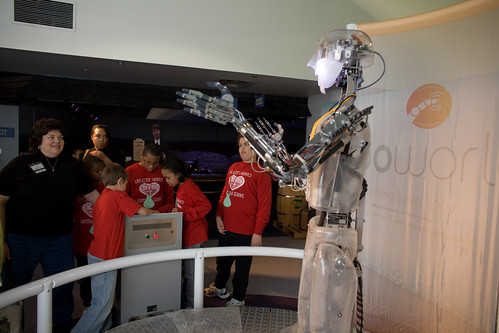
Carnegie Mellon teaches about robots; children hit random buttons and pretend to learn something.

I have not visited the Pittsburgh university, but the Robot Hall of Fame appears to be part of a growing focus on robotics at their Science Center. Just about this time last year, it was announced that "roboworld" would provide a permanent educational display about artificial intelligence and other such lovable automatons. As far as I can tell, the Robot Hall of Fame is nestled among these displays.

Since it was founded in 2003, the hall has inducted 26 robots, with eight arriving in last year's picks. Because scientists want to have fun too, the jury for choosing the inductees is made up of an international hodgepodge, with members ranging from late sci-fi writer Arthur C. Clarke to Steve "The Woz" Wozniak, a lowly co-founder of Apple. And these are serious deliberations, too, with jury teleconferences to discuss the relative merits of each nominee. You didn't hear this from me, but apparently Dr. Ruzena Bajcsy, a Berkeley electrical engineering and computer science professor, once exchanged blows with Anthony Daniels, the actor who played C-3PO, over the question of whether or not Agent Smith from the Matrix movies constitutes a robot.

Agent Smith grimaces upon learning that he was barred from consideration in the 2008 induction for stuffing the ballot box.

As it stands right now, the count is tied at 13 each for fictional and non-fictional robots. Of course, when you put them side by side, the non-fictional bots leave something to be desired.

Non-Fiction

  • Three Mars rovers (Pathfinder, Spirit, and Opportunity)
  • Two robotic manufacturing arms (Unimate and SCARA)
  • A medical system (DaVinci Medical Robot System)
  • A shuffling, faceless humanoid (ASIMO)
  • A robot named after its jerky motions rather than its groundbreaking ability to reason (Shakey)
  • Another bot with an unflattering nickname and a groundbreaker in the development of mobility (Railbert Hopper)
  • A self-steering minivan (NavLab 5)
  • A plastic puppy (AIBO)
  • A vacuum cleaner (Roomba)
  • A Lego toy line (Mindstorms)

Fiction

  • Three service drones assisting a rogue botanist in his attempt to save Earth's surviving forests (Huey, Dewey, and Louie)
  • Two droids who helped defeat a galactic Empire (R2-D2 and C-3PO)
  • An android and chief operations officer on board a starship (Lt. Commander Data)
  • A killer cybernetic abomination turned super-strong cybernetic bodyguard (T-800 Terminator)
  • A killer AI spaceship system (Hal-9000)
  • A hulking, shiny warning against nuclear war (Gort)
  • A metallic bourgeois doppelganger (Maria, of Metropolis)
  • A synthetic replacement child (David, of A.I.)
  • Another child-bot, with superpowers! (Astro Boy)
  • A bulky automaton who, if pop culture is to be believed, does nothing but shout that danger is about (Robby the Robot)

OK, so maybe scientists have some of those fictional creations beat, but for the most part they're getting outclassed. At least the non-fictional choices carry more weight, given the fact that they actually exist. Shakey, for example, looks like your standard ugly-but-functional creation but had rudimentary language capabilities and was able to figure out how to meet simple given instructions on its own. The Spirit and Opportunity rovers, meanwhile, are on another planet. And they're still working to gather information from Mars, even if they're almost as old as the Robot Hall of Fame itself. The fictional bots, meanwhile, are honored more for their place in introducing the robotic concept into popular culture. Though given the induction of the T-800 and HAL-9000, they're already dipping into the homicidal robot category just a bit; both of these creations started off as bad guys, then returned as protagonists in the sequel.

Spoiled a perfectly good ceremony by saying who all the inductees would be through 2029.

Carnegie Mellon has been a little lax in updating the hall's website, so the last detailed update only discusses the 2008 bots. Meanwhile, the nomination process allowed on the sites shows both the wide range of pop culture AI out there and puny human intelligence, dropping towards a point where ASIMO will be able to beat us by his ability to maneuver stairs. For example, Lieutenant Commander Data of the starship Enterprise has garnered a two percent favorable rating (the sixth highest of the list) from users despite the fact that he was added to the Hall of Fame two years ago; other nominations show numerous repeats or requests for bots already honored. The top contenders among the public are currently the cannon-wielding video game character Mega Man (who I always thought was more of a cyborg) and surly 30th century suicide booth manufacturer Bender Bending Rodriguez of Futurama.

I'm all for robots having their own hall of fame, and I think this will have a rather nice unintended side effect. There are a staggering number of fictional bots out there. Futurama alone can probably contribute dozens, ranging from soap opera actor Calculon to the Robot Devil. Then there's Dog of Half-Life 2, a scrap heap creation who can take on whatever the alien conquerors of Earth can throw at him; Wall-E, the souped up Roomba and savior of fatass future humanity; Rosie, the Jetsons' maid...the list goes on. If Carnegie Mellon doesn't want to start introducing nothing but fictional bots, then the techies are going to have to get cracking on those new designs.

Oh, and yeah...they should add Summer Glau. Obviously.

Breakthrough accomplishment: first robot to eat food. And still look good like this.

Sunday, February 28, 2010

Greatest Thing Of Anything: Barenaked Ladies

BNL rolled?

The first song I heard from the Barenaked Ladies was "The Old Apartment," one of their lesser known offerings. It showed up in 1997 on WEQX, getting fairly high up on the Canadian charts and only making it into the high 80s on the U.S. ones (it did have to compete with such utter masterpieces as "MMMBop," of course). It's kind of surprising to see that they've been around since 1988, slowly gaining steam in Canada before starting to seep into the American market with a couple of singles. They only really hit the scene with the release of the album Stunt the next year and its considerably more popular song "One Week."

The band has also been fairly consistent. Its members include Jim Creeggan, nicknamed "Grampah" for somewhat curmudgeonly behavior; Kevin Hearn, a leukemia survivor; Ed Robertson, a pilot who once safely crash-landed his Cessna; and Tyler Stewart, the drummer and only member who hasn't written a song. Two member transitions have occurred: Andy Creeggan, Jim's brother, who left in 1995 to go solo and co-founder Steven Page, who also left to go solo and briefly resented the other founding member (Robertson) in childhood for stealing his best friend.

It's difficult to class the members in the normal way, because they seem to be a general talent tour de force when it comes to what they play. For example, Jim Creeggan is the bassist, but that term includes both the bass guitar and the giant stringed instrument. There are plenty of other non-traditional instruments that make their way into the lineup, and it seems like everyone gets in on the creative end of things when it comes to getting the songs down on paper. And though the songs are ultimately imbued with a deeper meaning, their subjects are usually very specific and quite random. Here are some examples, of both their more popular and less well-known tracks, and what it seems they're about:

One Week: a sort of apology song following a relationship fight with numerous detours into pop culture and other references, including The X-Files, Snickers candy bars, and wasabi.
The Old Apartment: a "you can't go home again" song musing on a couple's former residence and the memories it holds despite the overall crumminess of the tenement.
If I Had $1000000: a song detailing what the band would do if they had a million dollars, with one proposal suggesting a treehouse with a mini-fridge containing pre-wrapped sausages.
If I Fall: a song about a window washer contemplating suicide.
Alcohol: a general song detailing the highs and lows every responsible user of alcohol has experienced after having a few too many at a party.
Light Up My Room: something of a love song involving a family that has some special electrical abilities thanks to the fact that they live near the power lines.

You've also heard these fellas signing the theme song to The Big Bang Theory if you're into geeky CBS comedies. It's well worth your time to listen to this two-minute extended version. Where else are you going to hear something rhymed with Australopithecus?


The band is also known for having exceptionally great live performances. The lead singer sounds pretty much the same way he does when on the records, and the band can get creative in the small songs and raps they introduce. For a time, fans also got into the practice of tossing boxes of Kraft dinner up on stage, though that was curbed once the microwaveable meals started to target the band members.

For full disclosure, I'll admit that I have only two BNL albums (Stunt and Rock Spectacle), haven't heard a number of non-single songs off the others, and haven't made seen them live. And of course they're not perfect; Page was busted for cocaine and marijuana possession in 2008, for example. And perhaps a group of people can't quite be characterized as a greatest thing of anything, and maybe it's not smart to praise anything Canadian after the United States just lost the Olympic gold medal in a hard-fought hockey game. But these guys are a lot of fun, and they certainly deserve what little honor this blog post can give them.

Monday, November 9, 2009

Greatest Thing of Anything: WEQX

I grew up in western Massachusetts, which was home to a few radio stations and got most of the other signals from Albany. And none of them were all that good. Quite a few fell along the lines of what I heard one comedian describe as something like "Kill Yourself Radio:" a lot of sad dreary songs about lost love, some with the sideshow of minor league baseball broadcasts. The others were your standard pop tripe, with the DJs apparently getting paid to overplay the latest hot single. Ultimately, I had to hunt and peck through the different frequencies, hoping to find something to like and not commercials.

That was how, in the late 1990s, I stumbled across WEQX.

The EQX crew in 2004 or so

I don't know why I didn't discover the station sooner. It may have been because it took me awhile to warm up to some of the harder rock, or it may have just been a little fuzzy until the antenna was pointed in the right direction, or it may have just happened to be on a commercial whenever I went past it. Whatever the case, I ended up tuning in to find nearly nonstop alternative rock, most of which the other stations had never bothered to pick up. The dial stayed there until I moved out of the area.

WEQX was founded in 1984, and has operated since then as an independent radio station. It prides itself on being more about the music than the commercials, and it lives up to the promise. The commercial breaks are short and mostly local, with the on-air talent often providing their voices to promote local events and businesses. So while some stations have commercial breaks that practically outpace the music, WEQX somehow manages to get by on breaks that are relatively non-obtrusive and, incredibly, mostly not annoying. The specialized programs include an all-request hour during the traditional morning commute (including a "Top 5 at 5" based on the most-requested songs throughout the day), a midday "retro lunch," a Saturday morning of acoustic and other more mellow music, and a Sunday night three-hour look at new music. The station has sponsored concerts and won several awards, including Rolling Stone's Best Radio Station of the Year three times.

Rather than some drab downtown brick structure, WEQX is based in a Victorian house in Manchester, Vermont. I've unfortunately never been there, though I'd be interested to see how it's divided up. The studio seems to be about standard size, and I'm sure most rooms are used for advertising and other such purposes. But the fact that they're broadcasting from a house just makes them that much more endearing. They even have pets, for crying out loud. Formerly it was just the EQX cats but now a pug has been added into the mix.

Fred, the EQX cat

Even the transmitting tower is in good company. WEQX broadcasts "from high atop Mount Equinox," a 3,848-foot-high peak in the Taconic Range from which the station gets its callsign. The mountain seems to be a little version of Mount Washington. One gets to the summit via a 5.2-mile toll road, and the tower is located within sight of a mountaintop hotel known as The Inn Atop Equinox that was established in the late 1940s. Assuming Wikipedia is to be believed, the mountain once held a NORAD defense station and also includes the remains of a tunnel system installed in the 1960s by a Vermont company seeking to install a cryonics system to freeze people with high IQs. What's more, the mountain includes a one-of-a-kind monastery on its slopes.

How the magic happens

I'm not sure if radio, like everything else on the planet, is in danger of becoming obsolete thanks to the Internet. I no longer live within listening distance of WEQX's transmission, and if I'm in the mood for rock or alternative I'll turn my radio to a similar station called WCYY. Most of the time I listen to NPR, the other station I heard a lot of growing up and one which, thankfully, has not changed much at all. But I spend a lot of time on the computer, and it's hard to compete with something like Pandora where you can simply plug in the songs and bands you like, not have to deal with commercials, and even skip a song if you don't like it.

So it doesn't have those perks, but WEQX is still something I'll be sure to keep tuning in to; thankfully, they're online too.

Friday, April 24, 2009

Greatest Thing of Anything: Keepon

Hey, remember those dancing plastic roses? Sure you do. My computer teacher had one in elementary school. It was the coolest thing in the world; of course, this was a time when computers had green screens that you could control with the color and contrast knobs, and you usually had to go and yell at your classmates to check the little red light next to the envelope symbol to make sure they got that message you sent them about how they're a jerk.

But just in case you don't remember, these things were potted plastic roses with guitars and sunglasses and little microphones in them, and if you played music near it the plant would wriggle around and the petals would open and close to make it seem like Elvis Petaly (yeah, well, you come up with something better) would open and close his stamens and pistols to make it seem like it was singing.

Dance!

It was...meh. It ran on batteries, as far as I remember, and those usually ran out pretty quickly. And it wasn't long before you realized that the flower had about all the dance moves as your average white high school freshman and it got kind of boring.

Enter the 21st century, and Keepon!

It's Keepon. I just said that, dumbass.

Keepon was developed by Hideki Kozima, and it's basically the dancing rose taken to the next level, namely sophisticated robotics for scientific study. Keepon's eyes are cameras, and there's a microphone in its nose. Despite its appearance (I believe a friend once described it as a "creepy Peep snowman") it has much more of a range than a dancing plastic flower. In addition, this is evidently being used to study the interactions with children and autism and whatnot.

WHY MUST EVERYTHING I LOVE BE A CYLON

Kozima, now a professor, could be a friggin' millionaire with this thing (and maybe he is), but it seems the only way you can obtain a Keepon is for educational or research purposes. Which means that you can't just write in the creators and say that you want a Keepon to keep at your cubicle to add some entertainment to your soul-crushing work day by making it dance to Spoon. Which is completely hypocritical on the part of the creators, of course, since they realized the full potential of Keepon to dance to Spoon. And not just one song, but two. Observe!


In conclusion, I want a dancing robot. Preferably Summer Glau, but Keepon will do.

Keepon vs. Glau...it will be a ratings smash hit