Showing posts with label games on a screen. Show all posts

Monday, February 16, 2015

Greatest Thing of Anything: The Lost Tribe

Combine a group of bumbling caveman, a scheming backstabber, and leadership responsibilities. What do you get? An excellent and memorable video game, as it turns out.


The Lost Tribe, developed by Lawrence Productions, was released as a PC game in 1992. As a reviewer on Moby Games notes, it has a bit in common with The Oregon Trail. Like that classic game, The Lost Tribe makes the player responsible for safely leading a group of people on a long journey to a new home. Except in this game, you're in charge of two dozen cavemen instead of a smattering of Missourians.

The game opens with the cataclysmic eruption of a volcano. The disaster kills your tribe's chief and best hunters, leaving a group of unskilled survivors homeless. Your only hope is to make the trek to another volcanic paradise, the home of your ancestors. You have been selected as the new chief. It's up to you to plot a course to your new home, keep the tribe happy and fed, and deal with whatever crises might arise.


Looking out for the welfare of 24 people isn't exactly an easy task, and the game works to keep you on your toes. There are a lot of moving parts to keep track of as you oversee what the tribe will do each day.

First and foremost is food. Each day, you have to decide whether the tribe will get a full meal, skimpier rations, or no grub at all. Much like the oft-decried real world element of The Oregon Trail that lets you slaughter as many buffalo as you want but only take 200 pounds back to your wagon, The Lost Tribe limits the amount of food a person can carry to three shares apiece. Hunting and gathering is an everyday task, meaning you have to pay attention to the attributes of your area when deciding what animal to go after. Enough unsuccessful hunts and you'll have to assign people half rations or send them to bed without dinner, increasing the chance that they'll become unhappy.

Time is at a premium in the game, but any effort you can make toward improving your tribe's hunting skills will be rewarded. You can skip hunting if you have enough food, passing the day by having the tribe practice with their spears; the more you practice, the more experienced the tribe will get and the more likely they'll be to succeed on a hunt.


A troublesome tribe member, fittingly named Burgle, is waiting for any opportunity to usurp your position. If people get too unhappy or lack enough confidence in your leadership, you lose the game and he takes over. Though the game's educational component is limited to an encyclopedia about various animals and primitive cultures and such, it helps to browse it to find out where you're most likely to find certain prey. Go hunting for bears in the plains and Burgle will convince part of the tribe to hunt with him for bison instead; if he's successful, it's that much more of a blow to your leadership.

There's also the disquieting fact that you're setting out just a few months before winter. Once this season starts, it becomes harder to find animals to hunt or plants to gather.


As if all this wasn't enough, you'll also have your leadership tested constantly with random daily events. These range from serious (people growing weak from walking through the blistering heat) to silly (deciding who to vote for in the tribe's election for a "drain commissioner"). Many of these situations give you great advantages, including enormous quantities of food, if you answer correctly. If you make the wrong decision, you might lose supplies or even suffer the loss of a tribe member.

Getting to your new home is the only way to win, and there are plenty of ways to lose. Burgle might take over as chief and banish you. The tribe will abandon you if too many people die along the way. And if you keep the tribe's confidence but don't get to your new home before winter sets in, you're treated to a haunting end of game screen showing the tribe frozen in their steps and buried in snow.

The game works to keep the tone light and amusing, even if it does periodically remind you that you're figuratively responsible for the lives of a large group of people. A con man named Piltdown appears wearing fur shorts and a cheesy tie. The stick figure animations showing how the hunt went usually feature a humorous sequence, even if a member of the tribe is killed (one shows a hunter throwing a spear into a tunnel-like cave, only to be run over by a train that rockets out with a bear in the tender). There's even some suggestion that this isn't exactly taking place in a prehistoric era; in one scenario, the tribe comes upon the rusting hulk of a car and wonders what to do with it.

Incremental increases in difficulty keep the game interesting. Higher levels have little if any of the map filled in, forcing you to explore and look out for signs left by your ancestors to find your way to your destination. They'll also start you off with less food, unhappier tribe members, and fewer days until winter. If you can overcome all of the challenges, you'll be greeted with a triumphant victory screen and some classical music rendered in MIDI.


The Lost Tribe isn't perfect, of course. Though modern day reviews have been positive, there are also complaints about how much your leadership relies on clicking the mouse. You're only assigning tribe members to do things, so you'll be disappointed if you expect to take an active role in bringing down a boar.

Still, this game is an excellent challenge and well worth a play. Check it out over at Abandonia.

Sunday, April 3, 2011

Break Out The Sad Tissues: The Dragon In My Dreams

I don't link too many sites off this blog, and there are various reasons for that. First and foremost is the fact that I like to write blog posts but generally have to construct them in bits and pieces during periods of free time, and they're sporadic enough as it is that I don't spend too much time working with the layout. There's also the fact that I don't have a huge array of websites that I follow, and I find that the ones I do generally give me a laugh after a day of work. One of the ones that updates more infrequently but is well worth it when it does is Cinemassacre Productions, home of the Angry Video Game Nerd.

"It fucking sucks, it sucking fucks, it fucking blows, it's a piece of shit...and I don't like it."

Rolfe first launched the Angry Video Game Nerd in 2004. It's a character rather than his true personality, since he's rather polite and soft-spoken in interviews while the Nerd is constantly sarcastic, enraged, profane, and psychotic. Using what seems like every video game system in the world and the crummiest of their associated games and devices, Rolfe then proceeds to rip into the flaws of each one, usually with a good deal of obscenity and over-the-top antics (up to and including the destruction of the most flagrant games).The videos vary in length, usually 10 to 20 minutes. Between scripting, editing, special effects, and other components, it seems like Rolfe usually manages to get one episode of the Angry Video Game Nerd out a month, although he also does a lot of videos on other pop culture from the 80s and 90s. Like any good nerd, he shows particular affection for Ghostbusters, Indiana Jones, and horror flicks.

One might be forgiven for watching Rolfe's Angry Video Game Nerd installments and assuming he's a "failure to launch" despite being an Internet celebrity. After all, his videos are mostly shot from a futon in a basement festooned with Nintendo Power magazines and a plentiful supply of Rolling Rock. This doesn't seem to be the case, though. Rolfe is mostly a private person, but has done some professional video work for Spike TV as well as a small videography company in Philadelphia. Somewhere along the way, he even got married.

Rolfe has shared several of his earlier projects, and one or two videos about his evolution as a filmmaker. Still, it was a bit of a surprise when Rolfe released a video looking into how and why he got into the craft:


The summary of this video, for those of you who didn't care to watch the entire thing: Rolfe drives along in search of his "fountain of youth," commenting how he's about to turn 30 and has made over 300 movies. Recalling how he's been wielding a camera since he was a child, he wonders where his creative drive comes from. He traces it to a recurring nightmare where he is attacked by a dragon. Rolfe visits his mother, who remembers how a concrete dragon feature was part of a park near the hospital where he was born and Rolfe thought it was awesome. Sometimes we're just drawn to the things that terrify us, he muses as he gives a brief biography of how he got into making movies, spent time in college, and held a variety of the jobs in the video field.

"I owe it all to the dragon, and now it's time for a reunion," Rolfe says as he pulls up to his old playground. He is overcome with emotion as he arrives at the dragon, aged and flaking paint but still standing. The park is under renovation and by a stroke of luck he's visiting on the last day the dragon will be as he remembers it in his childhood. "It's time to say goodbye to the past, time to move forward and create those movies in my dreams," he says. "Because dreams are where it all started." Rolfe looks back sadly as a construction worker resumes jackhammering around the dragon, then composes himself and drives away. The film concludes with the park (dragon still visible) fading into the distance, a short montage of photos from Rolfe's childhood, and a thank you to his parents.

Some of the movie has a bit of a staged feel to it, such as when Rolfe first reacts to the dragon. In fact, as this "outtakes" video reveals, Rolfe did indeed stage part of the video. He admits that the actual first encounter with the dragon in a couple of decades was different than what appears in the video, but also notes how you can see that his feelings are the same as what he portrays. He thanks the workers for letting him film the scene, wistfully commenting on the sentimentalism of others.

Still, there's something about the video that's very touching. To a certain degree, Rolfe is living a warped version of his childhood. He's usually in front of an NES or similarly antiquated system and surrounded by materials left over from when he was younger. He's still cranking out the Angry Video Game Nerd videos, so he hasn't entirely given up on it. But his final reflection is essentially Rolfe saying farewell to his past, which the dragon represents as something you can never revisit in exactly the same way. It's easy to get sentimental about the places from our childhood, especially as we get older and those places change.

I'm only a few years shy of Rolfe's age, and there are a lot of things from my childhood that I've lost, ranging from the original building my elementary school occupied to my uncle. It's a reflection on life: it's always a little bittersweet, as we are saddened by the things we lost and hopeful for what lies ahead. It's optimistic, but it can still bring a tear to your eye, though.

Saturday, February 5, 2011

Top 10 Half-Life Loose Ends

"I can't close my report until every loose end is tied up." --G-Man

I'm a fan of the Half-Life games, though I was a bit spoiled in that I started off with Half-Life 2, arguably the best in the series. In 2007 its second sequel, Half-Life 2, Episode 2 was released in a package with its two predecessors, which a friend deeded to me via the game platform Steam since he already had them. Half-Life 2 and its sequels have some pretty good graphics, great atmosphere, engaging characters, cool weapons, and in general a lot going for it. There's a third episode sequel set to come out and wrap up the entire series, but unfortunately the developer, Valve, has been dragging their feet on it. They've put their focus on the fan bases of the associated Portal and Left 4 Dead games, cranking out a couple of them while Half-Life languishes.

I doubt Valve has given up on the whole enterprise, especially when they're this close to concluding it. One possibility is that they're expanding the shorter sequels to Half-Life 2, which usually take about six hours to complete, to a full-fledged conclusion. There are more than a few questions that need to be answered, though. And here are my picks for them, with all images supplied via Combine Overwiki:


10. What's going on in the rest of the world?


Half-Life
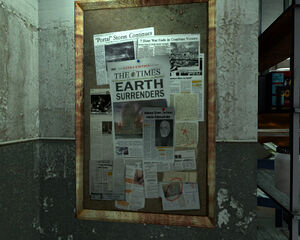
started things out at a classified research base in New Mexico, but the survivors of the Black Mesa Incident wound up in some locale in Eastern Europe known only as City 17. How exactly this happened is unclear, though it's hinted that Earth's population is being subjected to a lot of forced relocation. The Black Mesa administrator, Dr. Wallace Breen, negotiated a speedy surrender to the Combine, has chosen to live in relatively comfortable conditions atop the skyline-dominating Citadel and he and/or the Combine have opted to situate their headquarters in this location. The only other place we really see is New York City, in a newspaper clipping in Eli's workspace.

The Combine have put a halt to reproduction, meaning humanity's been slowly dying off for 20 years when Gordon is reawakened. Still, there must be a fairly significant population left and the games from Half-Life 2 on have all been in City 17 and the vicinity. Obviously, this constitutes only a small portion of the planet. Are there other strongholds on Earth, perhaps Cities 1 through 16? How's the resistance there doing?

Likelihood of resolution: Unlikely, considering we don't even know exactly where City 17 is. Half-Life games have always kept in one general area, and even with Gordon and Alyx likely to fly to a polar region they probably won't be stopping off in Berlin for a quick jaunt. The game probably won't end in a single, smashing victory against the Combine that liberates Earth, either. And as a post on TV Tropes points out, even if the Combine are defeated the planet will still be infested with Xen wildlife, with most of the original Earth species extinct.

9. What happened to the rest of the Xen creatures?


Through the course of Half-Life, Black Mesa is invaded by a wide variety of creatures from Xen. These include zombifying little things called headcrabs, electricity-shooting Vortigaunts, long-tongued barnacles, water-dwelling icthyosaurs, acid-spitting bullsquids, blast wave-producing houndeyes, hovering humanoid aliens that shoot energy balls at you, armored troops with arms that fire insect-like ammunition, and gigantic Gargantua beasts. In the sequels, the first four make an appearance although the Vortigaunts have become your allies and the icthyosaur makes a cameo. The rest of the creatures are never seen.

The explanation no doubt has to to with the developers not being able to cram everything into Half-Life 2, and the game is probably better for keeping only some of the old enemies and introducing new ones. Still, it's unclear whether other Xen creatures are roaming about and what may have happened to the ones that disappeared after their initial invasion.

Likelihood of resolution: Unlikely. The sequels ditched a few aliens and brought a few new ones in, and the players seem to be happy with that.

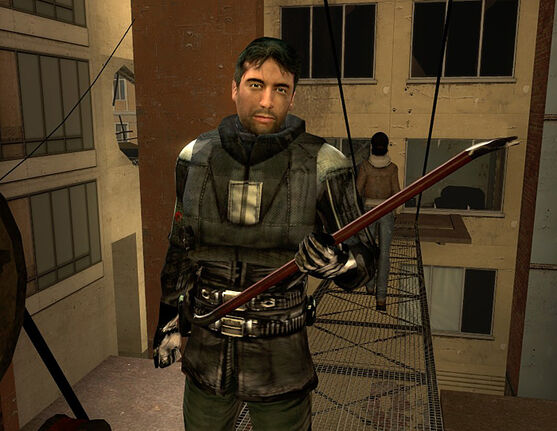
8. Where is Barney Calhoun?


Like most of the Half-Life characters, Barney Calhoun is much-beloved: resourceful, slightly sarcastic, and battle-hardened. He makes his first appearance in Blue Shift, a pre-Half-Life 2 expansion, where he manages to rescue a few scientists and get away from Black Mesa in the midst of the chaos. After that, he sticks with the Black Mesa crew and infiltrates Civil Protection, a low-level unit of civilian collaborator troops, to assist the City 17 resistance from within.

In what may have just been a case of too little room, Barney doesn't make an appearance in Episode 2. He is last seen in Episode 1, on board a train evacuating City 17 with several other civilians. It had several minutes' head start on a second train boarded by Gordon and Alyx, which was derailed in the Citadel explosion, but there was no word as to whether Barney's train outran the blast. Gordon and Alyx spend most of the second episode fighting their way to the White Forest base, meaning we don't see any other characters in person until they get there. To that end, it makes sense that Barney is excised although it is a little odd that he doesn't make so much as a cameo (with the arguable exception that he congratulates Gordon on a job well-done at the end of a massive battle that concludes Episode 2) while an entirely new character is introduced. With Gordon set to head to a new environment, it remains to be seen whether Barney will be along for the ride.

Likelihood of resolution: We may not figure out what he's been up to in the interim, but it seems likely that we'll see him again.

7. How much has G-Man's original plan been altered?


Half-Life 2 ended with G-Man on the verge of putting Gordon into stasis again after only a few hectic days on the Combine-dominated Earth (or weeks if you count the jump through time in a collapsing portal). In that short time, he accomplishes quite a bit: he decimates many of the Combine defenders in City 17, inadvertently starts a major uprising, kills Dr. Breen, and causes the full-scale meltdown of the dark energy reactor atop the Citadel. At that point, G-Man freezes time and prepares to cart Gordon off, leaving Alyx to die in the explosion and his former Black Mesa colleagues and other rebels to fight for themselves. But then the Vortigaunts step in, rescuing Gordon and Alyx and keeping them in the present time.

It doesn't seem like too much is affected by Gordon staying put. The Citadel melts down, destroys the city, and leaves a gaping superportal overhead which threatens to bring the full brunt of Combine reinforcements to Earth. It's sealed later on when Gordon helps fight off a last-ditch attack on another rebel stronghold and a rocket is launched to take care of the problem. It's kind of up in the air as to whether the resistance could have handled this on their own, but Gordon certainly helped things along. It's entirely possible that the rocket would have failed to launch, given that Gordon and his gravity gun were the main factors involved in destroying the powerful Striders advancing on the base. So what was G-Man's original plan for Gordon, and when and where was he going to be deposited next? Did G-Man aim to help the resistance in some way or allow Combine forces to come to Earth and wipe out humanity once and for all?

Likelihood of resolution: This question is likely to be resolved when we find out what the deal is with the G-Man.

6. What are the Vortigaunts planning?


From their ability to wipe out a massive invasion of antlions with hand-fired bolts of electricity to their seemingly psychic ability to heal Alyx, the Vortigaunts are some seriously powerful creatures. Their show of staving off the G-man and rescuing Gordon and Alyx from the Citadel after stopping or slowing time is certainly their most impressive act thus far. How they were able to perceive what was going on, get to the top of the Citadel, and deliver the two to safety before disappearing is likely to remain just another mystery as to how they can do what they do.

However, it begs the question of what the Vortigaunts have in mind. Were they just trying to rescue a couple of resistance members and happened to interfere with the G-man along the way? Or is G-man a force of evil that they're trying to fight?

Likelihood of resolution: It's possible that this might get swallowed up as a bit of a plot hole, or simply ignored. The Vortigaunts have allied with humanity, but given that they speak in riddles on larger matters they might keep it somewhat cryptic.

5. Will Race X return?


In Opposing Force, Adrian Shepherd witnesses Gordon jumping into the portal to Xen; from there, he sees what goes on at Black Mesa in that unseen time after Gordon's departure in Half-Life. The main development: a completely different set of aliens who start infesting the facility and provide cool new weapons such as an electro-burst biological arm and another living weapon that shoots balls of acid.

And then the aliens simply disappeared. Part of this seems to be a result of Adrian Shepherd defeating the giant worm poking his head through a portal in the final boss; Combine Overwiki said this is a "Gene Worm," a forerunner of Race X colonization efforts. Perhaps Race X would have been duking it out with the Combine for domination of the planet, but the defeat of the worm left Earth to the Combine.

Likelihood of resolution: Race X may have simply been written out with the above scenario. It's unlikely that we'll see them again, despite some fans' hope to get a chance to electrocute things again.

4. Is Adrian Shephard coming out of stasis?


Opposing Force rounded out the perspectives on the first Half-Life game quite nicely. The original was from the viewpoint of Gordon, a scientist, and it was followed by Barney, a security guard, in Blue Shift. Opposing Force put you in the boots of Adrian Shephard, one of the rather unsympathetic grunts who spent the prior games gunning down Black Mesa employees in a poorly executed cover-up plan. Shephard crash-lands in the action not long before Gordon teleports to Xen and is prevented from evacuating by G-Man, leaving him to clean up the Race X invasion virtually unassisted. G-Man thanks him for this job well-done by getting him out of the facility before it is obliterated by a nuclear weapon, having had to make a case for keeping Shephard alive, and detains him pending "further evaluation." Shephard hasn't been seen or heard of since.

By humanizing the soldiers and adding some G-man interaction pretty much on the par of what Gordon experienced, Shephard became fairly popular with players and there has been a decent amount of speculation as to whether or not he will return. The closest thing to a reference to him has been in companion game Portal, which features keyboards with the letters included in Shephard's name highlighted. The developers claim, somewhat unconvincingly, that it is a mere coincidence.

Likelihood of resolution: Episode 3 is likely to be the last game in the series. If Shephard shows up, he may have to get a secondary speaking role unless the first-player action switches between him and Gordon. It seems like it might be a little difficult to shoehorn Adrian into this part of the narrative, however, so he might be left off.

3. What is on board the Borealis?


One nugget which will have to be explored before the series wraps up is a mystery introduced in Episode 2. A bit of data painstakingly smuggled out of the Citadel and brought to White Forest by Alyx shows footage of the Borealis, a ship belonging to Aperture Science that mysteriously vanished, along with a portion of the dry dock, back in the days before the Black Mesa Incident. Kleiner thinks the discovery of the ship means the resistance can turn the tables against their foe, while Eli thinks doing so could lead to a catastrophe on the level of the one that got Earth invaded in the first place. Mossman, meanwhile, is apparently in the region fighting Combine defenders to try to get to the ship while advance art shows the thing already swaddled in Combine mech.

As a more video game savvy friend pointed out, the clues are pretty much all there as to what will be in the ship. In Half-Life 2, Mossman mentions that the Combine are struggling to develop the teleportation technology that the resistance has gotten relatively under control. In this way, they have a slight advantage over their alien overlords (which increases once an invincible badass physicist enters the fray). The Borealis, meanwhile, is the property of the company featured in Portal: a game about a gun that allows you to use a handheld device to create inter-dimensional doorways. Uh-oh.

Likelihood of resolution: Certain. Valve wouldn't introduce the Borealis without taking care of the question of what's on board.

2. How do you defeat a Combine Advisor?


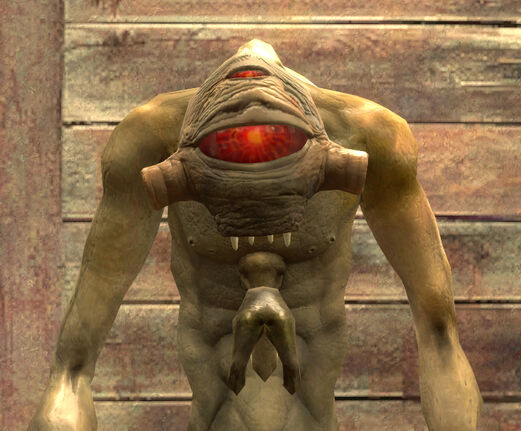
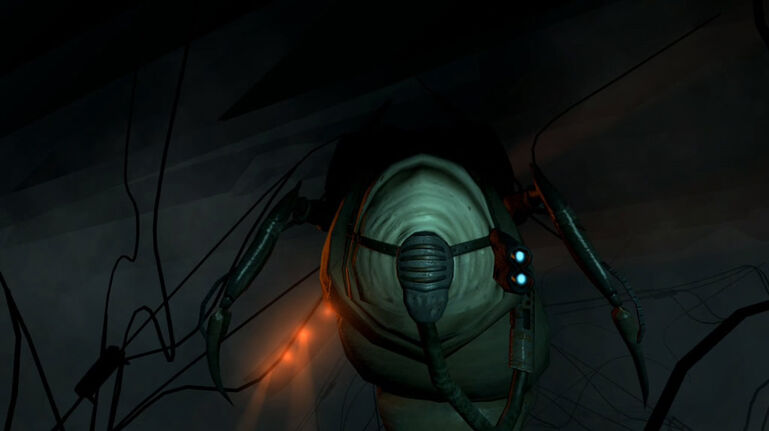
The Combine Advisors may be the brain bugs behind the entire invading force. Resembling giant grubs, they make their first appearance in Episode 1 and Gordon has several unpleasant close-ups in Episode 2. The Advisors are ridiculously powerful, having the ability to telekinetically hold people in place (or break them in half). Getting near one leads to some psychic bursts that impair your vision and coordination. When we last saw them, the Advisors were sucking out some of Eli's vitals.

It looks like the Advisors can be hurt. Eli gets in a few whacks with a pipe before he's killed, and Gordon and Alyx are saved because Alyx's pet robot DOG comes in and wrestles an Advisor, sending it scurrying off. The developers have said you'll go head to head with at least one Advisor, but there's still the question of whether you can do that with your existing weapons or if you'll need a new one.

Likelihood of resolution: Should be addressed, given the developer commentary.

1. Who/what is G-Man?


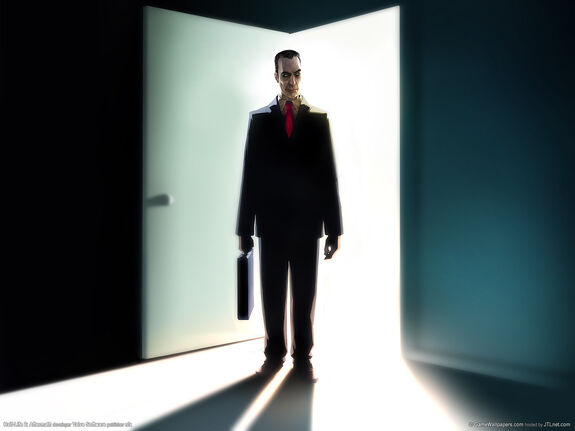
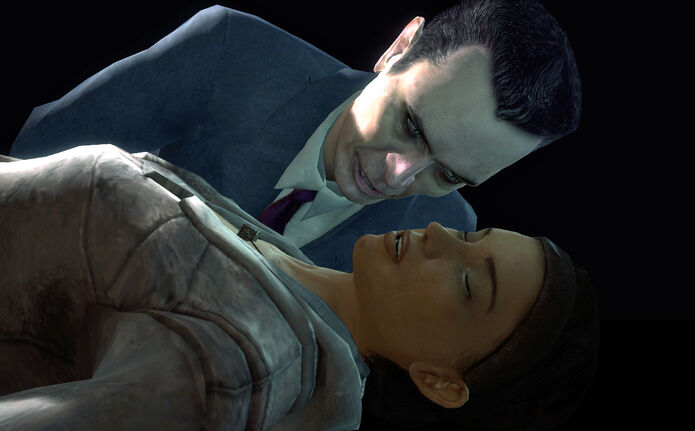
This is the big one. G-Man first showed up in the original game, watching Gordon's progress through Black Mesa from inaccessible points and finally appearing to Gordon after he defeats the game's big bad. The final sequence suggests that G-Man might not even need Gordon that much, since a refusal of his job offer merely sends Gordon off to die in some alien-infested landscape. Indeed, he's shown to have had some interaction with Eli, Alyx, Breen, and Shephard, and was apparently keeping an eye on Barney for awhile. G-Man seems to be something of a chessmaster, putting people in situations and seeing what they can do, but also takes direct action such as reactivating the nuclear bomb at Black Mesa after Shephard defuses it.

It's unknown whether G-Man is trying to help the resistance or the Combine, or whether he's falling somewhere in between. It's not even clear what he is. He obviously has some superhuman abilities, what with the ability to stop time and all, and one description suggested that he seems like something doing a somewhat passable impression of a human. Another suggestion is that he is Gordon from the future, a theory plausible enough that it may have been the original intention but may now be something different if the developers decide they need a more surprising reveal.

Likelihood of resolution: This is what people have been wondering about for 12 years. They'll have to offer some sort of explanation.

Saturday, May 29, 2010

Internet Killed the Everything Star

Once upon a time, there was a video parody of "Video Killed the Radio Star," the song by The Buggles that was the first music video MTV featured in the wee hours of an August morn in 1981. In that context, The Buggles are kind of assholes, since they're bragging that they're going to kill a particular form of media. Not to worry, radio is still kicking and MTV's quality imploded like a collapsing star after ditching music videos in favor of a hodgepodge of "edgy" shows and dynamiting a number of quality animated series (Clone High and Undergrads among them) to protect the suckiness. And then there was this:


I remember seeing this video back when Shockwave was a cool new Web application offering various animated videos and online games. It apparently hasn't changed too much, but this video is already dated. The Internet services are offered through CD-ROMs? And they include Compuserve? And there's still reason to include a Netscape logo in the mix?

My relationship with the Internet is probably about the same as what I have with gasoline: I realize it has a lot of negative effects, but I friggin' need it. I work at a newspaper, and hear plenty of jokes and dire stories about how the Internet is gleefully killing us and everything else on the planet. At the same time, I spend plenty of time online checking out various websites or Netflix. The resources available online are pretty much the only thing that lets me keep up my other website by doing research in news archives and books whenever I want. And if I, say, wanted to see Summer Glau, let's see how different the paths are between whether I have Internet and whether I don't. Ready? Go!

Internet Me does a quick search on Google Images. And for good measure, I carry it through to this blog with a few keystrokes.

So the Internet has this going for it. Which is nice.

Meanwhile, Non-Internet Me is trying to catch a repeat of The Sarah Connor Chronicles, or seeing if some magazines might have a shot available. Or I could be taking a cross-country road trip to Hollywood complete with hilarious pratfalls to see the lovely Ms. Glau in person...whereupon I would most likely get mace-Tased right away by her personal security or crushed by her powerful robot arms.

So how much harm or good is the Internet causing in various areas? Let's find out together.

The Video Star, ie Music Videos

I'll always have a special liking for the alternative rock songs that appeared in the late 1990s, since that was generally a good time for music and also the time I discovered WEQX. The music videos of the time weren't really special, but I do remember a few of them. They include Oasis playing with a bunch of military helicopters in an industrial ruin, Radiohead's incredibly weird animated video featuring a limbless EU delegate and other such oddities, and the front man of The Verve plowing a straight line walk through a busy London street. Those are all British bands, I realize. So be it.

I've already mentioned how MTV has pretty much ruined itself, so I won't dwell on that. Strangely enough, music videos have grown more popular since people have stopped watching them on television. It makes sense, really. More people use the Internet than watch MTV or VH1, and the bands apparently realize that if something becomes a viral hit they'll receive much more exposure than they might otherwise get. To that end, music videos have become incredibly awesome. They include the Flobots' animated dystopian future, Depeche Mode's short movie featuring a sort of hostage situation with a man in an out-of-control car, and Mutemath lip-syncing their song in reverse to terrific effect. OK Go are the undisputed kings of the new video scene, having put out amazing videos featuring a backyard choreographed dance, a seamless routine on treadmills, and the best Rube Goldberg machine ever made.

So kudos to the Internet on this one. MTV can keep their crummy reality shows if it means music videos are consistently entertaining now.

Record Stores, CDs, and Radio

There are still a few record stores around, and some chains seem to be doing fairly well (see Turn It Up in New England and Cheapo in the Midwest). And I wish them well, because they both have a nice atmosphere and, well, a ton of CDs. Though I have to confess that I haven't bought any discs in quite some time. I don't have an iPod, so it has more to do with listening to the radio and saving any song I really like as a favorite in YouTube. That and the fact that I'm kind of cheap. Illegal song downloads have been around since the Internet was fast enough to sustain them, but it hasn't destroyed the music scene. By having music be available mostly online or through iTunes, though, it seems like CDs and the stores that sell them might be on the way out. Guess it's time to welcome a vacancy in the mall for a little while before letting another Starbucks move in.

Radio, I'm hoping, will endure. It's possible to play tunes off the iPod in vehicles, but it certainly seems unfair to require someone to pour thousands of dollars into a car and then demand that they go out and buy an iPod to fill with their desired songs and podcasts. So cars will always have stereo systems included in them, and hopefully radios will be a part of that. Plenty of radio stations are chock full of good music with minimal commercials and some pretty good DJs to boot. And then there are all of those concert giveaways and tornado warnings that radio brings you.

Guess they don't make a podcast for that.

Movies and Video Stores

One can pick up an illegal movie download as soon as a movie premieres, if not sooner. But that really can't compare to dropping some money every now and then to hit the theater and see something on the big screen. Not everything needs to be blown up to massive proportions with a nice sound system to get the full effect, though, and I do watch online movies on Hulu or Netflix in smaller windows. So any decline in movie revenues can be attributed to people holding onto their cash to put toward more essential needs or people deciding they don't want to see dreck like Furry Vengeance.

Dear fucking Christ

The Internet can't really be blamed for the gradual decline of video stores, either. The very fact that they're still called video stores when VHS has pretty much disappeared from the market isn't a good sign. And ironically enough, the true threat to them is Netflix and other mail-in services, which utilize the post office, which the Internet also threatens to some degree. It's much easier to have a DVD mailed directly to your house, or stream it online, than make a trip to a video store and face late fees. Though if the Internet kills the post office, you can never get movies ever again. Except bootlegs or a more extensive online stream network, which can be ported directly to your television. Dammit.

Television

It's pretty much the same thing as movies. It's not like commercials weren't already interludes that let you get a snack or take a bathroom break, but TiVo has taken things to the logical conclusion by letting you skip them altogether. Hulu and other streaming sites offer pretty much the same perk: wait a day, miss the water cooler talk, and watch your show with only a scattering of 30-second ads. Of course, these ads can repeat themselves ad nauseum.

Overall verdict: television has had a few golden ages, and though it seems to have progressed from a "stupid reality shows" phase to an "endless cop shows" phase, there are plenty of terrific dramas and comedies out there and the Internet is probably helping them more than hurting them. It was pretty much the entire reason for the writer's strike back in 2007-2008, after all. All told, the Internet is much less threatening to television than the team that makes creative decisions at Fox.

Canceling this, and Arrested Development, and Greg the Bunny, and so on = Rupert Murdoch is going to the special hell

Video Games

Online games are about as graphically advanced as the old Playstation games. The real issue lies in their addictiveness. XKCD already said it very well:


Newspapers and Journalism

So here's my plan: I'm going to bury my head in the sand and ignore any and all bad news I hear related to newspapers.

A terrible strategy, I know, but I'm currently stuck in a situation which is neither dire nor ideal and I'm sure that's how the newspaper industry can be described as a whole. For all the jokes about every newspaper and magazine in the country fading into nothingness in a matter of months, they are still looked upon as a trusted source of local news (and national news, though there are plenty of people who criticize those as "liberal media" while implicitly trusting anything on Fox News). A newspaper subscription is cheaper than an Internet package, but of course a newspaper doesn't come with access to anything and everything ever produced. And those of us who grew up reading the funnies have realized that most of the comics now are bloated relics kept trundling along by an original artist's offspring while the stuff that makes you laugh has migrated online, where amusing people with some degree of artistic skill can reach a wider audience.

So newspapers are in trouble. They apparently can't afford to keep teams like Woodward and Bernstein focused on important stories, and the people who get fired are more likely to be the experienced reporters at a higher pay grade than the cubs who aren't paid much. At the same time, there's always a demand for news, and there seems to be a corresponding demand for accountability. Newspapers might convert into an online product or something like the version of the Minority Report version of the USA Today that morphs to incorporate breaking news, but it seems like there will always be a place for journalism. As long as journalism in general doesn't go off the rails into completely editorial territory.

If that thing leaves the island, that's it. It's over. Everything.

The post office

Which is easier: typing dozens of words per minute in an "electronic mail" that can be quickly and instantly sent to someone, or carefully scrawling out a letter and envelope, spending forty-some-odd cents to send it on its way, and getting it to the mailbox or post office where it will proceed to a destination within a few days.

For idle conversation and other routine correspondence, e-mail is ridiculously convenient. And with companies everywhere urging people to go paperless, will there come a time when the mail system simply collapses for lack of anything to distribute other than glossy junk mail? Well, hopefully not. Sending out cards for someone's birthday or other special events should be firmly in place. I don't think sympathy e-cards where a cartoon duck consoles you the loss of a loved one will catch on. And then there's always Netflix. Sweet savior of the postal system, Netflix!

Books and bookstores

And perhaps Giles on Buffy the Vampire Slayer said it best for this one: "Smell is the most powerful trigger to the memory there is. A certain flower, or a-a whiff of smoke can bring up experiences long forgotten. Books smell musty and-and-and rich. The knowledge gained from a computer is a - it, uh, it has no-no texture, no-no context. It's-it's there and then it's gone. If it's to last, then-then the getting of knowledge should be, uh, tangible, it should be, um, smelly."

Apparently books are doing fine, even if they're being printed on paper and that's dying out and allowing trees to grow back and cure the planet of all its ills. Granted, most paperbacks published in North America are romance novels. Tell me, does the strapping guy with the pecs the size of Ohio get the fair maiden? Spare me the suspense! Still, there's something about relaxing in bed or a favorite chair with a good book. We're not at the point where everything had to be on the screen, are we?

Compact discs? How primitive the Martian libraries of the year 3000 are.

Language and grammar

Perhaps the biggest drawback of the Internet is that some idle browsing can inculcate the idea that the human race has gotten stupider since we can hide behind a pseudonym and post messages that look like the ramblings of a drunken 10-year-old. Some people probably post these things to be ironic, but, as Jon Stewart would say, YOU'RE NOT HELPING. Text messages have certainly helped in diluting words to as few letters as can be managed, and then of course Twitter came along. Have a thought? Please be sure to condense it into 140 characters or less, and use the number sign to join thousands of other people in commenting on some current event, or the @ symbol to try to get the attention of celebrities. Oh, if only William Faulkner were alive to take part in it!

I probably shouldn't be so crotchety. For the most part, the Internet is well-versed and coherent, with scholarly articles and widespread collections and a plethora of random sites like this one with the occasional (hopefully forgivable) lapses in spelling or grammar. Still, I'm unclear how a funny cat video can devolve into a debate over whether or not America sucks. And though hilarious, there's always PeopleofWalMart.com and Lamebook (aka, "White Trash Gets A Facebook Account) to make us question the human race.

But I guess I can't really take too intellectual of a stance here considering the section I'm going out on.

Porn

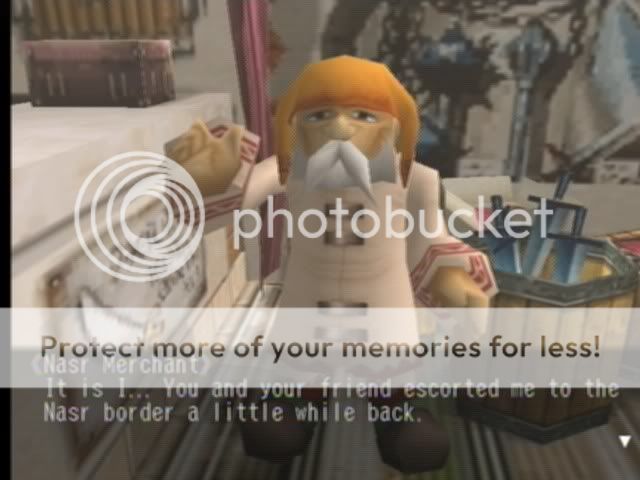
"So you're looking for pornography, are you?" asks the kind Internet Merchant. "Well, I guess I can help you out. I've got a couple of billion images if you care to browse. About the same number of videos, too. It's all free, of course. And you can surf it all from the privacy of your own home instead of going into some sketchy shop or trying to buy a dirty magazine from some store clerk while waiting in line right in front of a Catholic grandmother getting Flintstones tablets for her three grandchildren. Is that all right with you?"

He's quite nice, this Internet Merchant.

You know what? Porn is like the cockroaches after a nuclear blast. It'll always be around, because it's a constantly changing thing. If the Romans took the time to make pornographic pictures out of hundreds of pieces of colored tile, I imagine pornography will always be riding in the wave of new technology like a top-notch surfer. Perhaps newspapers could learn a thing or two from it.

I'll be in my bunk.

Sunday, March 28, 2010

Crossover I Want To See: Frisky Dingo vs. Half-Life 2

The Participants

"Mmm, whose saddle is this? That's Uncle Taint's!"

Frisky Dingo
: A short-lived Adult Swim series created by the guys who made Sealab 2021 and more recently made Archer for FX. Only two seasons aired, featuring posh pseudo-villain Killface and billionaire playboy/idiot/superhero Xander Crews as the main characters. Killface spends the first season unsuccessfully trying to alert the world to the fact that he possesses a doomsday device, and the second season running for President of the United States after said device inadvertently solves the problem of global warming. Along the way, we become acquainted with a gang of imbecilic robot-armored soldiers and the harrumphing clones of an old man, among others.

Badasses with crowbars will always triumph over alien oppression.

Half-Life 2: A very successful sequel to the somewhat lo-fi but still very enjoyable computer game Half-Life, the series picks up to find Gordon Freeman in a world conquered by alien life forms and totalitarian occupiers, as the planet has been conquered by the entities released during a lab catastrophe in the first game. Awakened from stasis by the mysterious "G-Man," Freeman joins a resistance movement to fight back against the sinister Combine forces. Along the way, he takes down tripod war machines, head-humping alien crabs, zombified humans, and an entire friggin' city.

The Crossover Point

Robert Guillaume

Meet Robert Guillaume. He's earned his acting chops (and a couple of Emmy Awards) from work on the series Benson, as well as another series entitled Soap. He even had his own show for a short time in 1989, before making a more smashing return to the public sphere by voicing Rafiki in The Lion King. He picked up a few other voice credits after that film, after no doubt realizing that his voice is enviable and awesome.

One of the gigs Guillaume picked up was for Dr. Eli Vance, a key character in Half-Life 2. Vance is an essential part of the human resistance, and appears in the game at various safehouses and other locations that Gordon Freeman happens upon in his swath of destruction through extraterrestrial fauna and other baddies. A scientist and former co-worker of Freeman's, Vance is one of the warmest in a set of genuinely likable characters. He maintains an upbeat attitude; shows a strong compassion for Freeman and his daughter, and gets in a few jokes about the romantic tension which seems to exist between the two; and, fictionally at least, is responsible for the wonder that is the Zero Point Energy Field Manipulator, or Gravity Gun.


I'm unfamiliar with Guillaume's earlier stuff, but in his voice work he seems to focus on playing the good guy. His characters have the feel of ultra-cool grandparents. Rafiki and Eli Vance have a lot of similarities, even if the former is in a dark yet still G-rated children's movie and the latter shows up in a mature-rated video game with plenty of blood spatter.

And then there's Mr. Ford.


Pretty much every person in Frisky Dingo is seriously lacking in morals, but the show's creators somehow got Guillaume to voice one of their more churlish and profane characters. Which isn't to say that Mr. Ford isn't downright hilarious. It's just that he isn't above providing security at illegal "death rabbit" matches in Chinatown or poisoning his way to the Presidency.

For whatever reason, Guillaume is not credited for the role. Google searches combining his name with Mr. Ford or Frisky Dingo, or either term with Eli Vance, come up with nothing. Perhaps Guillaume wants to keep the credits for his voice work limited to virtuous roles, but there's no reason someone can't have a little fun creating a mashup of Frisky Dingo and Half-Life 2.

How It Would Be Done

Simple: Mr. Ford's dialogue in place of Eli Vance's for various scenes in the game.

And it could probably work for The Lion King, too...